
Scaling a Roofing Company From $1M to $5M to $10M
Roofing Growth, Operations, Leadership
What Separates a $1M Roofer From a $5M Roofer and a $10M Roofer?
Moving from roughly $1 million toward $5 million in revenue usually depends on one primary shift: transferring repeatable work from the owner’s shoulders to accountable people and documented processes. Moving from $5 million toward $10 million depends on a different shift: stronger coordination across sales, production, management, and cash flow so growth does not erode margins or create service failures. These are common management challenges to assess, not universal rules. The practical question for any roofing owner is this: Which part of the business would fail first if qualified demand increased?
A Simple Economic Lens: The Hypothetical Comparison
Before talking leadership and processes, it helps to look at the math. We will use a hypothetical comparison so you can see the workload behind each revenue level. The revenue points of 1 million dollars, 5 million dollars, and 10 million dollars are illustrative comparison points, not universal operating stages. Assume the following for your roofing business.
Average completed job revenue: $15,000
Lead to completed job rate: 10% (10 inquiries produce 1 completed job)
Contribution per completed job after incremental selling and delivery costs, including applicable commissions, before marketing and fixed overhead: $4,500
Annual marketing cost per acquired job: $1,500
For this example, all modeled revenue is assumed to come from this acquisition program, with one completed job per new customer. Actual roofing businesses usually have a mix of sources, repeat work, and referral volume that change the economics.
With those assumptions, here is what it takes to reach the illustrative 1 million dollar, 5 million dollar, and 10 million dollar annual revenue levels. The inquiry requirements are planning estimates. Holding conversion, job contribution, and acquisition costs constant is a way to manage workload and economics in your planning. It does not predict your future economics, which will move as your market, pricing, and team change. Required jobs are rounded upward, so the modeled revenues are approximately 1,005,000 dollars, 5,010,000 dollars, and 10,005,000 dollars.
Annual Revenue Target | Required Completed Jobs | Required Inquiries (Leads) | Marketing Budget (per Year) | Contribution after marketing, before fixed overhead |
|---|---|---|---|---|
$1,000,000 | ≈ 67 jobs ($1,000,000 ÷ $15,000) | ≈ 670 inquiries (10 per job) | ≈ $100,500 (67 × $1,500) | ≈ $201,000 (67 × $3,000) |
$5,000,000 | ≈ 334 jobs | ≈ 3,340 inquiries | ≈ $501,000 | ≈ $1,002,000 |
$10,000,000 | ≈ 667 jobs | ≈ 6,670 inquiries | ≈ $1,000,500 | ≈ $2,001,000 |
These contribution figures are after marketing and before fixed overhead. They are not net profit. Whether your exact numbers are higher or lower, the pattern is consistent. Every step up in revenue is a step up in jobs to deliver, inquiries to handle, and cash to manage. That is where the real separation between a 1 million dollar roofer, a 5 million dollar roofer, and a 10 million dollar roofer begins.
From $1M to $5M: Transferring Work From Owner to System
Around the 1 million dollar level, many roofing businesses still rely heavily on the owner as the primary system. Typical owner responsibilities include:
Personally approving most estimates, pricing, and discounts
Qualifying most leads based on personal judgment rather than defined criteria
Stepping into production whenever something goes wrong
To move from roughly 1 million dollars toward 5 million dollars with your margins intact, it is useful to assess how much work still depends on direct owner execution versus defined processes and accountable roles. That assessment often leads to a shift from owner execution to team execution. That shift can include:
Documenting qualification criteria for which inquiries deserve an in person appointment
Assigning clear responsibilities for answering phones, following up, and booking inspections
Creating step by step processes for how estimates are built, presented, and followed up
Key Takeaway: At this stage, it is important to examine how many routine decisions and approvals still flow through the owner and how that affects response times, workload, and service quality.
From $5M to $10M: Coordinating Sales, Production, Management, and Cash
Between 5 million dollars and 10 million dollars in annual revenue, many roofing companies find that they can no longer rely on extra effort to manage complexity. The risk often shifts from the owner doing too much personally to departments not being coordinated. You may already have sales reps, a production manager, and office staff, yet you see:
Sales booking more work than production can install without overtime and mistakes
Cash crunches despite strong revenue because draws, supplements, and payables are misaligned
Service failures such as missed appointments, slow callbacks, and warranty delays as volume rises
At that point, what separates a 5 million dollar roofer from a 10 million dollar roofer is not just more marketing or more crews. It is stronger coordination across functions, for example:
Weekly alignment between sales and production on capacity, backlog, and start dates
A management cadence that reviews margin by job, by rep, and by crew, not just total revenue
Cash flow planning that connects pay schedules, supplier terms, and marketing commitments
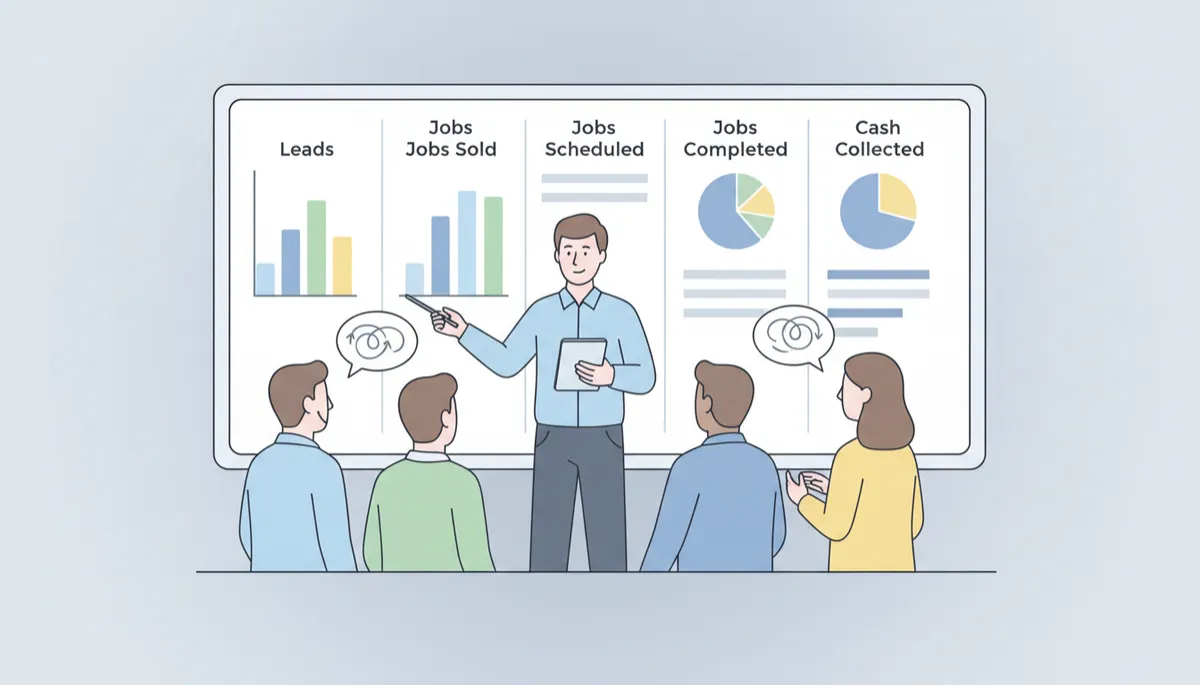
Coordination meetings keep sales, production, and cash aligned as volume increases.
The ActivatorSystem Growth Constraint Framework
At ActivatorSystem, we organize these issues into a practical growth constraint framework built around five questions. This is not about proprietary technology. It is about giving you a clear way to assess where your business is most likely to struggle as you grow.
Demand: Do you have a reliable way to generate enough qualified inquiries at a known cost?
Conversion: Are you consistently turning inquiries into profitable jobs at a predictable rate?
Delivery: Can you install and service those jobs on time, at quality, without blowing labor and material budgets?
Ownership: Who owns each step and are they accountable to clear standards and metrics?
Cash: Does cash come in fast enough, and stay controlled tightly enough, to support the workload?
When you ask, Which part of the business would fail first if qualified demand increased? you are really asking which of these five constraints will show up first. The answer is often different near 1 million dollars, 5 million dollars, and 10 million dollars, and it should guide your next investments in people, process, and marketing.
Transitioning From Owner Execution to Team Execution
Consider a fictional company, Summit Peak Roofing, at 1.2 million dollars in annual revenue. The owner, Mark, insists on approving every estimate before it goes to the homeowner. His logic is sound. He wants to protect margin and avoid mistakes. In practice, it creates a bottleneck.
Estimates sit in Mark's inbox for 24 to 48 hours when he is on roofs or in meetings
Sales reps cannot follow up quickly, so prospects wait for information and some choose other providers
Mark feels buried, so he hesitates to invest in more leads
The shift to team execution for Summit Peak Roofing can be designed with clear rules and checks.
Document qualification criteria: What zip codes, roof types, job sizes, and insurance situations are ideal? Which are acceptable and which are no quote?
Standardize estimate rules and timelines: Create pricing templates, margin targets, and discount boundaries so trained reps can build most estimates without Mark's review, with a defined deadline for estimate delivery and a recorded next action on every opportunity. For example, each estimate includes a follow up time and owner, captured in the system.
Create an exception queue: Build a simple queue for estimates that fall outside standard rules, where Mark or another senior leader reviews only those items that truly require higher level approval.
Assign process ownership: One coordinator owns inbound inquiries and appointment setting. Each sales rep owns their follow up cadence and documentation of next actions. A production manager owns job handoffs and schedules.
These changes are measurable. Summit Peak can track time from inquiry to first contact, time from inspection to delivered estimate, and conversion. It is also important to track quality and economics alongside conversion, including errors in estimates, customer complaints, contribution per job, and owner hours spent on approvals and rework. Delegation should be evaluated on all of these dimensions, not assumed to improve close rates by itself.
Pro Tip: If the owner must still touch every job, your company is likely capped by the owner's personal capacity rather than by the market. Clear rules, training, and exception handling can reduce that constraint.
Common Pitfalls as Revenue Grows
As ActivatorSystem works with roofing and exterior contractors, there are well known, avoidable mistakes that frequently appear. They cut across many revenue levels and directly affect your ability to manage workload and economics as you grow.
Treating revenue growth as profit growth. Revenue can increase while profit stalls or declines if job mix, discounting, and rework are not controlled. It is important to track contribution and profit per job, not just topline.
Buying inquiries without capacity. Turning on more ads when your phones, estimators, or crews are already at capacity can create waste and poor customer experiences. Demand planning should reflect realistic capacity and service commitments.
Hiring without clear accountability. Adding a sales manager or operations manager without clear metrics and authority simply adds payroll. Every role should connect to a specific constraint in Demand, Conversion, Delivery, Ownership, or Cash.
Expanding geography without measuring costs. Chasing more zip codes or new states increases drive time, supervision complexity, and marketing dilution. Measuring job profitability by geography can inform whether expansion is a strategy or a habit.
Allowing the owner to remain the approval point. If every exception, discount, or schedule change must be cleared by you, you become the ceiling. A 10 million dollar roofer typically relies on standards and trained people who can make defined decisions within those standards.
Five Concrete Action Steps to Scale Intelligently
Map your current constraints. Using the ActivatorSystem growth constraint framework, answer honestly. Is your primary limitation Demand, Conversion, Delivery, Ownership, or Cash? Ask, What would break first if I doubled qualified leads for 90 days?
Measure the constraint. Put numbers on it. For example, track average days from inquiry to inspection, jobs per crew per week, days sales outstanding, or percentage of calls answered live. You cannot manage what you do not measure.
Assign owners and standards. For each constraint, assign a single owner and define success in a way that fits your workload, service commitments, and economics. Standards should reflect the experience you want customers to have and the margins you need to sustain the business, rather than generic benchmarks.
Test improvements. Make one or two focused process changes, then measure again. For example, implement a structured follow up sequence or a weekly production meeting and see how close rate, rework, and team workload change over 60 to 90 days.
Increase demand only when capacity supports it. Once Delivery, Ownership, and Cash are stable at your current level, then expand Demand through marketing and search. This is where marketing and client acquisition services such as those provided by ActivatorSystem can support additional demand when the contractor’s capacity and economics justify it.
Six Brief FAQs on Growth, Hiring, Leads, Profitability, and Delegation
1. Do I need more leads or better conversion?
Look at your numbers. If your schedule is light and your close rate is already strong, you likely need more qualified demand. If your schedule is full but close rates are weak, focus on how your team handles inquiries and presents value before buying more traffic.
2. When should I hire my first sales rep or production manager?
Hire when the owner's workload in that function is consistently beyond capacity and you can define clear outcomes for the role. Tie the position to a measurable constraint such as backlog days, close rate, or jobs completed per crew, not just being busy.
3. How many leads do I really need to reach my target?
Use the hypothetical comparison as a planning tool. Take your revenue target, divide by average job size to get jobs needed, then divide by your actual lead to job rate to estimate inquiries. Adjust quarterly as your conversion, pricing, and job mix evolve.
4. Why does profit not grow as fast as revenue?
Because complexity, overhead, and mistakes can scale faster than you expect. Overtime, rework, discounting, and poor job selection all erode contribution. You need to design growth around protecting margin per job, not just adding jobs.
5. How far can I delegate without losing control?
Delegate defined decisions to trained people with clear authority, reporting, and escalation rules. The owner retains responsibility for oversight.
6. How do I decide between growing to $5M or pushing toward $10M?
Start with your goals and risk tolerance, then assess your current constraints. If Delivery, Ownership, and Cash feel fragile at 3 to 4 million dollars, stabilizing around 5 million dollars with strong profitability may be a better near term focus before aiming at 10 million dollars. Scale should serve your economics and lifestyle, not the other way around.
A Practical Next Step
Want to identify what is limiting your next stage of growth? Share your annual revenue, monthly lead volume, close rate, average job value, and where your team gets backed up. ActivatorSystem can help you assess the acquisition and follow up side of the problem.
You can start that conversation by requesting a strategy consultation with ActivatorSystem at this link. https://www.activatorsystem.com/contact-page.