
Turn Roofing Leads Into Jobs, Reviews, and Referrals
Roofing Marketing, Roofing Lead Conversion, Roofing Business Growth
How to Turn Roofing Leads Into Jobs, Reviews, and Referrals
Turning a roofing lead into real business requires a defined roofing sales process where every inquiry has an owner and a clear next step. A practical approach looks like this: assign every new inquiry to a responsible person, qualify suitable prospects and book an appointment, complete the inspection, present a clear written estimate, deliver the promised work, request an honest review, and make referrals simple with a clear way to introduce you. Each stage of roofing lead conversion needs a defined next action and a measurable outcome. More advertising alone does not ensure that these steps happen. A completed project can generate proof and recommendations that support future inquiries. This cycle is not automatic. You have to design and manage it.
The Economics Behind Roofing Lead Conversion
Before you increase advertising, you need to understand what your current roofing lead conversion actually produces. Here is a clearly labeled hypothetical example to illustrate the economics of roofing business growth. These are not ActivatorSystem client results or industry benchmarks. They are simple numbers to make the math concrete:
$4,000 advertising spend
40 unique leads
20 booked appointments
14 completed estimates delivered to homeowners
4 sold jobs
$13,000 average job value
$52,000 potential project revenue if all four jobs are completed at that value
Metric | Calculation | Result |
|---|---|---|
Cost per lead | $4,000 ÷ 40 leads | $100 per lead |
Lead → appointment rate | 20 appointments ÷ 40 leads | 50% |
Booked appointment → delivered estimate rate | 14 estimates ÷ 20 appointments | 70% |
Estimate → sold job rate | 4 jobs ÷ 14 estimates | ≈ 28.6% |
Overall lead → sold job rate | 4 jobs ÷ 40 leads | 10% |
Advertising cost per sold job | $4,000 ÷ 4 jobs | $1,000 per sold job |
Project revenue ÷ ad spend | $52,000 ÷ $4,000 | 13:1, if the revenue is realized and attributed to the campaign |
Notice that the 70% figure from booked appointment to delivered estimate combines appointment attendance and estimate delivery. It is not a pure show rate. It reflects how many booked appointments result in an estimate actually being put in the homeowner’s hands. Also, distinguish between sold contract value, completed project revenue, and cash collected. The $52,000 here is potential project revenue if all four jobs are completed at the $13,000 average. Revenue divided by advertising spend is not profit or full marketing ROI. Agency fees, software costs, sales labor, production labor, materials, overhead, and other expenses are excluded from this example. ActivatorSystem encourages owners to look at these numbers clearly before deciding where to improve or scale.
The ActivatorSystem Roofing Growth Flywheel
ActivatorSystem uses the Roofing Growth Flywheel as a practical planning framework for organizing both client acquisition and customer experience. The framework connects each stage to an owner, a next action, and a measurable outcome. The stages are: Lead → Appointment → Estimate → Job → Review → Referral. For roofing business growth, each stage should define what must happen, who owns the next action, and what to measure.
Lead: Capture, Qualify, and Assign Ownership
What must happen: Capture the inquiry in your CRM, record its source (Google Ads, referral, yard sign, website, etc.), check service and location fit, and assign an owner. This is where roofing lead conversion starts. If nobody owns the lead, nothing else matters. Basic qualification on roof type, location, urgency, and service needed helps you focus on opportunities that fit your business.
Who owns the next action: Typically your office coordinator, inside sales rep, or a dedicated lead manager. In smaller companies, it might be the owner. ActivatorSystem’s approach is to make this explicit so no inquiry is left in limbo.
What to measure: Track unique leads and qualified leads by source. This is the first step to understanding your roofing marketing economics.
Appointment: Turn Interest Into a Confirmed Visit
What must happen: Agree on a specific time, confirm expectations (inspection, estimate, who should be present), clarify access details, and send appropriate reminders by text or email. Opportunities can stall here because of poor fit, scheduling friction, or inconsistent follow up. Review the records before deciding which issue to address.
Who owns the next action: Usually the office or call center, with the salesperson or estimator responsible for confirming and attending. The key is that someone is clearly accountable for confirming the visit and updating the status.
What to measure: Measure booked appointments and completed visits separately. Do not blend them. This lets you see whether issues are happening at the booking stage or with no shows and reschedules.
Estimate: Deliver Clarity and a Defined Next Conversation
What must happen: Complete a thorough assessment, document photos and notes, and deliver a clear written estimate with scope, materials, pricing, and payment structure. Agree on when and how you will review the proposal or follow up, on the spot, by phone, or via a scheduled call. Roofing lead conversion often stalls because the estimate is delayed, unclear, or never actually presented.
Who owns the next action: The salesperson or estimator. They are responsible for delivering the estimate and scheduling the next conversation, not just emailing a PDF and hoping for the best.
What to measure: Track delivered estimates and estimate to sold job conversion. This shows how well your roofing sales process turns real proposals into signed contracts.
Job: From Signed Contract to Completed Project
What must happen: Separate a signed contract from completed work. Manage scheduling, permitting, material ordering, crew coordination, site protection, and clean up. Communicate clearly about start dates, weather delays, change orders, and punch list items. Address unresolved concerns before closing the file. This is where your brand promise is either confirmed or damaged.
Who owns the next action: Production or operations, with oversight from the owner or a project manager. Sales should also stay lightly involved so the homeowner never feels abandoned once the contract is signed.
What to measure: Track sold jobs, completed jobs, project value, and job margins. This helps you see whether marketing and sales are bringing in work you can deliver profitably.
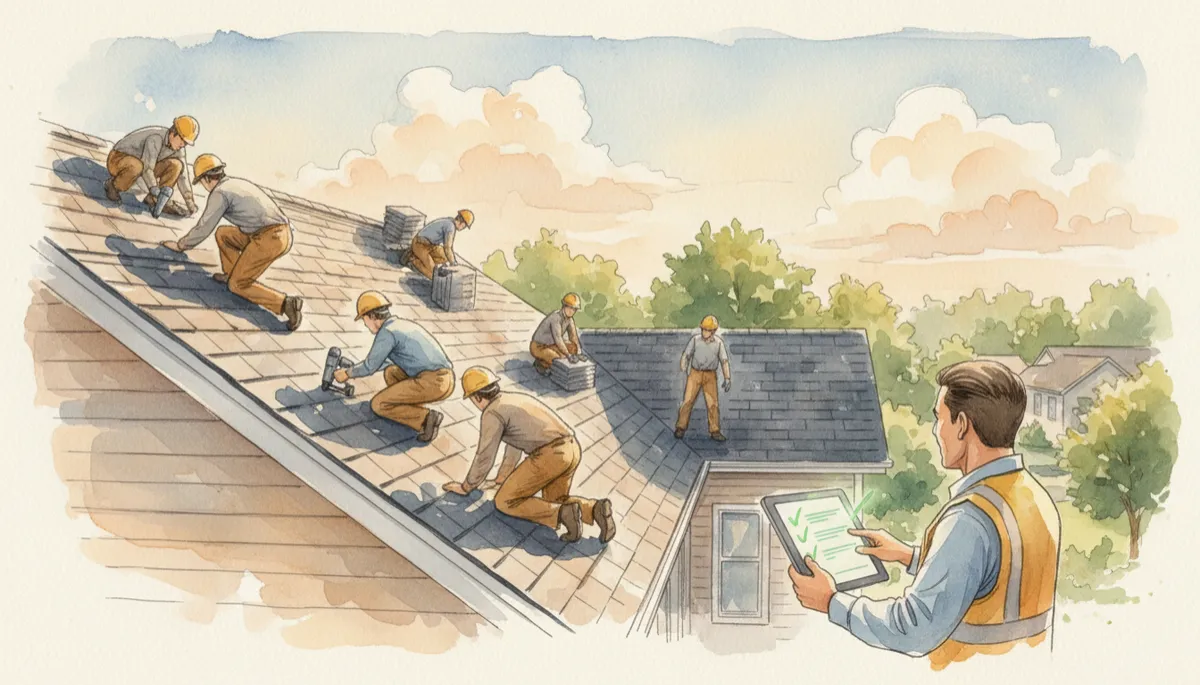
Consistently managed projects create the proof that fuels future reviews and referrals.
Review: Request Honest Feedback Through a Consistent Process
What must happen: Request an honest review through a consistent process after project completion. Provide a direct link and simple instructions. Do not select customers based on satisfaction or expected rating, offer incentives for Google reviews, or make additional help conditional on a review. Handle service concerns separately.
Who owns the next action: Often the salesperson or a customer success coordinator. The important part is that review requests are built into your close out checklist, not left to memory or mood.
What to measure: Track review requests and published reviews, without promising or targeting a specific rating. Over time, this supports your roofing referral marketing and your ability to convert future leads.
Referral: Make Introductions Simple and Trackable
What must happen: Make it easy for customers to introduce someone who needs roofing work. Offer a shareable contact link, a short referral card, or a simple email template they can forward. Invite an introduction rather than a vague “keep us in mind.” A referral request does not require a public review first. Reviews and referrals can happen independently after the job.
Who owns the next action: Sales or customer success, supported by your CRM and marketing automation. ActivatorSystem, for example, focuses on making these touchpoints structured and repeatable, not random.
What to measure: Track referred inquiries, qualified referral leads, and resulting jobs separately. This shows how effective your roofing referral marketing is and prevents you from overestimating its impact.
The Return Path: How Completed Jobs Feed the Next Cycle
When you complete a project, you create assets that can support future roofing lead conversion: authentic photos, customer feedback, and introductions. With appropriate permission, photos and testimonials can be used in ads, on your website, and in follow up sequences. Reviews help new prospects evaluate your company. Referrals introduce you to homeowners who already trust you more than a stranger from a search result. Those new inquiries reenter the Roofing Growth Flywheel at the Lead stage, and the cycle continues. The power comes from managing the full journey, not just turning up the advertising budget.
A Worked Example of the Next Cycle: Reviews and Referrals in Action
Continue the earlier hypothetical numbers. Suppose all four sold jobs are completed successfully. As part of your close out process, all four customers receive an honest review request. Two of them choose to publish a review. One of those customers also introduces a neighbor who needs a roof replacement. That introduction creates one additional inquiry. It is not an automatic sale and should not be treated as guaranteed revenue.
Here is how that referral should move through the Roofing Growth Flywheel:
Lead: Record the neighbor as a new lead in your CRM. Mark the source clearly as a referral from the specific customer, not just “word of mouth.” This keeps your roofing referral marketing measurable.
Appointment: Qualify the project (location, service type, timing) and book an inspection if it is a fit. Send confirmations and reminders as you would for any other lead.
Estimate: Complete the assessment, document the roof, and deliver a clear written estimate. Agree on a follow up conversation to review questions and next steps.
Job: If the neighbor signs, manage the project like any other: schedule, communicate, complete the work, and resolve issues.
Review and Referral: After completion, request an honest review and offer an easy way for the new customer to introduce others.
Do not add assumed referral revenue to the original $52,000. Until the referral becomes a completed job, it is simply a new opportunity entering the same process. Also, do not assume that two reviews will automatically produce a specific ranking or conversion improvement. Reviews help, but they work alongside your broader roofing lead conversion and marketing efforts. Finally, while referrals often have no direct advertising charge, they still require time, systems, and follow up. They are not truly “free.”
What Most Roofers Get Wrong (And How to Fix It)
Many roofing companies work hard yet feel disappointed with their marketing results. Often, the issue is not effort but missing structure. Here are common mistakes to check for, along with practical corrections that respect the realities of lead quality, pricing, competition, and capacity.
Measuring lead volume without tracking completed jobs. Correction: For every campaign, track the path from leads to sold jobs and completed jobs. This shows whether your roofing lead conversion is healthy, not just busy.
Treating booked appointments as attended appointments. Correction: Separate “booked” from “completed visit” in your CRM. Review no show and reschedule rates so you can improve reminders, confirmations, and time windows.
Treating an estimate sent as a sale. Correction: Track how many delivered estimates turn into signed contracts. Add a defined follow up step, call, text, or email to review the estimate and answer questions.
Treating signed contracts as collected revenue. Correction: Distinguish contracts from completed projects and cash collected. This keeps your roofing business growth grounded in actual delivery and payment, not just paperwork.
Stopping customer communication after the contract is signed. Correction: Build a simple communication plan from contract to completion: scheduling updates, pre start expectations, progress notes, and a final walkthrough. This reduces cancellations, disputes, and negative surprises.
Requesting reviews inconsistently or selectively. Correction: Request honest reviews through a consistent process after project completion, without selecting customers based on satisfaction or expected rating. Handle service concerns separately from the review request. This builds a trustworthy profile over time instead of a handful of hand picked testimonials.
Asking vaguely for referrals without an easy next step. Correction: Replace “please tell your friends” with a specific ask and tool: a referral link, a card, or a short message the customer can forward to someone they know.
Assuming every satisfied customer will leave a review or refer someone. Correction: Recognize that even happy customers are busy. You need clear requests, simple tools, and gentle reminders to turn satisfaction into roofing referral marketing results.
Counting the same customer or inquiry multiple times. Correction: Use a CRM that deduplicates contacts and clearly tracks one opportunity through stages. Merge duplicate inquiries about the same project while preserving legitimate separate projects from the same customer. This prevents inflated lead counts and misleading conversion rates.
Increasing advertising before understanding the weakest stage. Correction: Use the Roofing Growth Flywheel to identify your bottleneck, such as lead qualification, appointment completion, estimate follow up, or project delivery. Strengthen that stage before adding more leads.
A Five Step Action Plan You Can Start This Week
Step 1: Map the Six Stages in Your CRM
Create or update pipeline stages that mirror the Roofing Growth Flywheel for sales and production: Lead, Appointment Booked, Appointment Completed, Estimate Delivered, Job Sold, Job Completed. Track review requests, published reviews, referral requests, and received referrals using separate fields, tasks, or workflows. These activities can happen independently and should not force every customer through one sequential pipeline. A referred homeowner should enter as a new opportunity linked to the referring customer. Make sure booked appointments, completed visits, delivered estimates, sold jobs, and completed jobs are clearly distinguishable. This is the foundation for accurate roofing lead conversion data.
Step 2: Assign an Owner and Next Action to Every Opportunity
Review your current pipeline and make sure every open lead, appointment, estimate, and job has a named owner and a defined next action with a date. For example: “Call to confirm appointment,” “Review estimate with homeowner,” or “Schedule final walkthrough.” This prevents opportunities from aging out simply because nobody was responsible for the next step.
Step 3: Review a Recent Batch of Leads and Run the Numbers
Choose a recent group of leads from a period that has had enough time to reach an outcome, for example, leads from two or three months ago. Using consistent definitions, calculate:
Lead to appointment rate
Booked appointment to completed visit rate
Completed visit to delivered estimate rate (if separate)
Estimate to sold job rate
Sold job to completed job rate
Then calculate advertising cost per sold job for that period, using the advertising spend that generated the selected group of leads and the sold jobs attributed to that group. Do not mix one period’s spending with unrelated sales closed during that period. This gives you a clear picture of where your roofing sales process is strong and where it is leaking opportunities.
Step 4: Standardize Your Project Completion, Review, and Referral Process
Build a simple checklist that runs from “job scheduled” to “job closed.” Include touchpoints for customer communication, final inspection, handling punch list items, requesting an honest review, asking permission to use project photos, and offering an easy referral invitation. This turns every completed job into a structured opportunity for roofing customer reviews and referrals instead of a one time transaction.
Step 5: Improve One Weak Stage, Then Consider Additional Spend
Based on your numbers, pick the weakest stage, such as lead qualification, appointment completion, estimate follow up, or project close out, and design one or two practical changes. For example, tighter pre qualification questions, better reminders, or a scheduled estimate review call. Monitor results over the next cycle. When your economics and production capacity support it, then test additional acquisition spending, ideally through an integrated system like ActivatorSystem that connects advertising, lead capture, CRM, automated follow up, and AI supported communication. Inspections, estimates, closing, and project delivery remain the contractor’s responsibility. Do not promise yourself results within a fixed period. Commit to measuring and adjusting.
FAQs on Roofing Lead Conversion, Reviews, and Referrals
What is a roofing growth flywheel?
A roofing growth flywheel is a simple way to view your entire customer journey as a repeatable loop instead of a one time transaction. Each completed project can create proof and introductions that feed the next round of leads, supporting long term roofing business growth when managed intentionally.
How do you turn roofing leads into booked appointments?
Respond quickly, but also focus on structure. Assign every lead to an owner, qualify for service and location fit, and offer clear appointment windows. Use text and email reminders, confirm who will be home, and restate what will happen during the visit. Track both booked and completed appointments so you can improve your roofing appointment setting instead of guessing why leads do not convert.
What should roofers track between an appointment and a sold job?
Track whether the appointment was completed, whether an estimate was delivered, and whether that estimate was reviewed with the homeowner. Then track estimate to sold job conversion. This shows if your roofing sales process is losing opportunities because visits do not happen, estimates are delayed, or follow up is weak, not just because “people are shopping around.”
When should a roofing company ask for a review?
Request an honest review at a consistent milestone, such as the final walkthrough or project completion. Provide a direct link, avoid incentives, and invite feedback regardless of the rating you expect. Continue addressing service concerns independently.
How can roofers get more customer referrals?
Deliver a reliable experience, then make referrals easy and specific. At project completion, thank the customer, explain who you help best, and provide a simple way to introduce you, a shareable link, card, or short message they can forward. Follow up politely with referred contacts as you would any other lead. Over time, this structured approach supports roofing referral marketing far more effectively than occasional, vague requests.
How do you measure whether roofing marketing is profitable?
Start by tracking leads, sold jobs, and completed jobs by source. Calculate cost per lead, cost per sold job, and project revenue attributed to each campaign. Then factor in agency fees, software, sales labor, production costs, and overhead to assess profitability. Revenue divided by ad spend is only one piece. True profitability comes from combining accurate roofing lead conversion data with your actual job margins and capacity.
Turn Your Roofing Pipeline Into a True Growth Flywheel
When you see your business through the Roofing Growth Flywheel, you stop chasing “more leads” and start building a system that consistently turns inquiries into completed projects, reviews, and referrals. ActivatorSystem is built to support roofing and exterior contractors with an integrated client acquisition platform that connects advertising, lead capture, CRM, automated follow up, and AI supported communication into one optimized process. Want us to look at your numbers? Share your cost per lead, lead to sold job close rate, and average job value. ActivatorSystem can help you identify which stage deserves a closer look.