Best Lead Sources for Roofing Companies in 2026
Roofing, Lead Generation, Client Acquisition
The Best Lead Sources for Roofing Companies in 2026
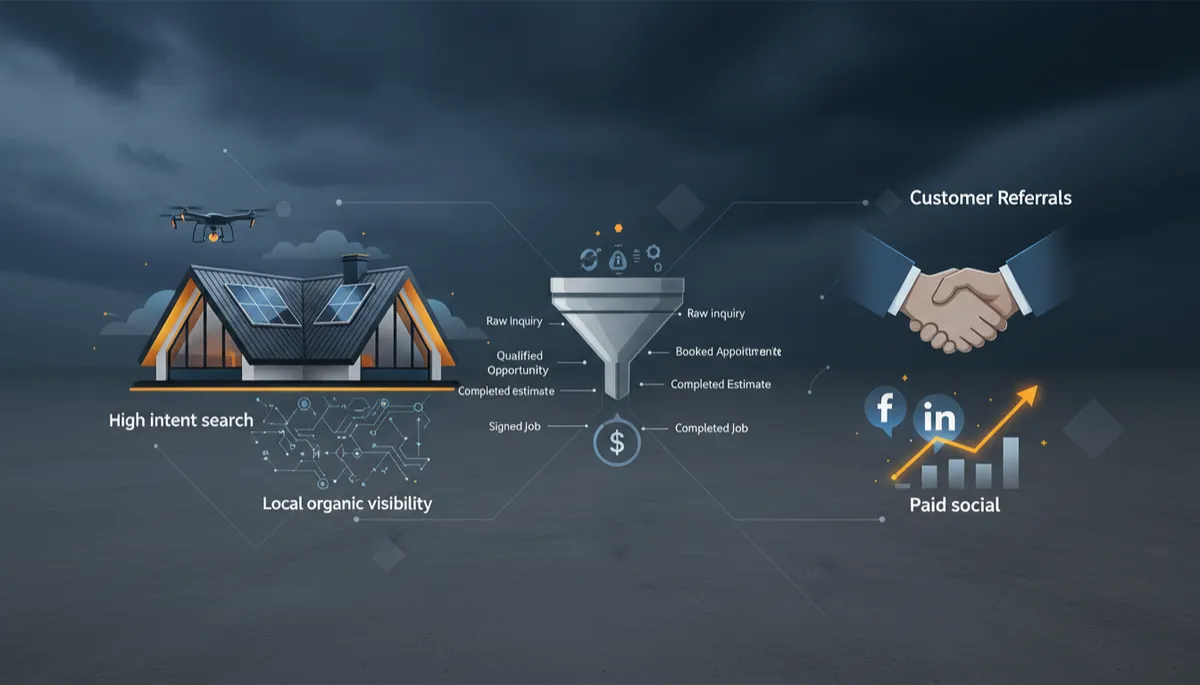
In 2026, the best lead source for a roofing company is not a single channel. It is the mix that fits your projects and economics. Every roofing leader should evaluate high intent search, local organic visibility, customer referrals, local partnerships, paid social, and third party lead providers against one question: “Can we profitably turn this source into completed jobs at our current pricing, close rates, and production capacity?” That requires defining exactly what you are buying from raw inquiry through signed and completed jobs, then choosing sources that align with your target project types and margin structure, not with industry hype or headline cost per lead numbers.
Start by Defining Exactly What You Are Buying
Before you compare Google, Facebook, referrals, or lead providers, you need a precise definition of the unit you are buying. Without this, economics are difficult to evaluate and vendors can label very different stages as a lead.
Raw inquiry: An initial call, form submission, message, or chat that has not yet been qualified. Contact details may be incomplete or unverified.
Qualified opportunity: A unique project where successful communication with a homeowner or authorized decision maker confirms service area, service fit, a genuine roofing need, recorded timing, and an agreed next step. Immediate purchase intent or a booked appointment is not required at this stage.
Booked appointment: An agreed inspection or estimate appointment. Booking confirms agreement on timing and purpose but does not establish attendance.
Completed estimate: The contractor has completed the assessment and delivered the proposed scope and pricing. An inspection or insurance submission alone does not necessarily establish a completed estimate unless scope and pricing have been presented.
Signed job: An accepted contract. Track deposits separately rather than requiring a deposit for this stage so you can see both contract value and cash timing.
Completed job: The contracted work has been completed. Track invoicing, collected cash, outstanding balances, and callbacks separately so you can see operational and financial outcomes beyond completion.
Be explicit about the word exclusive. Exclusivity describes a provider’s distribution agreement: whether a raw inquiry or other stage is supplied to one contractor or to multiple contractors. It does not establish qualification, prevent the homeowner from contacting other contractors, or guarantee a sale. You still need to evaluate quality, project fit, and your own handling.
The Core Lead Sources Roofing Companies Should Evaluate in 2026
For most roofing companies, the realistic lead source universe in 2026 clusters into seven categories. Each can play a different role depending on your project mix and economics.
Source | Potential fit | Main constraint |
|---|---|---|
Google Search Ads | Can reach people searching for relevant roofing services. Economics depend on local competition, search intent, inquiry handling, and the inquiry destination. | Requires clear targeting, suitable landing experiences, and reliable tracking to understand acquisition outcomes. |
Google Local Services Ads | An option to evaluate where available and where the contractor is eligible. Assess actual inquiry relevance, costs, and conversion outcomes. | Availability, eligibility, and policy requirements can affect participation and volume. |
Local SEO and Google Business Profile | Support discovery through relevant local searches and map results for your services. | Require accurate information, useful service pages, authentic project evidence, and ongoing work to maintain and improve visibility. |
Customer referrals | Can introduce prospects who already have some level of trust in your company. Volume depends partly on your installed customer base and referral activity. | Require consistent service, clear communication, and any applicable program costs such as rewards or thank you gifts. |
Local partnerships | Can introduce projects through property managers, real estate professionals, insurance contacts, and complementary contractors. | Depend on suitable relationships, mutual expectations, and clear handoffs so inquiries are handled properly. |
Facebook and Instagram advertising | Can introduce a specific service or offer to people who may not be actively searching for roofing services. | Require appropriate creative, targeting choices, and follow up so you can evaluate project fit, qualification, completed estimates, and acquisition costs. |
Third party lead providers | May supply inquiries under different distribution agreements, including shared and exclusive arrangements. | Require careful review of project types, service areas, duplicate handling, replacement or credit terms, and conversion economics. |
The ActivatorSystem Lead Source Fit Framework
Use the ActivatorSystem Lead Source Fit Framework as a practical way to evaluate what to test, scale, or pause. It applies four checks to each lead source in your mix.
Project: Does the source attract the services, property types, and locations the contractor wants? For example, search terms that reference specific roof systems in your service area can align differently than broad general roofing terms or inquiries from outside your preferred geography.
Economics: What is the total acquisition marketing cost per qualified opportunity, completed estimate, and signed job? This includes media or provider charges and associated acquisition marketing expenses, not just the headline cost per inquiry.
Control: Who controls the advertising accounts, website, contact records, tracking, and follow up? Control depends on the agreement and setup. Ownership and access affect how quickly you can adjust campaigns, correct issues, or change providers without losing data.
Capacity: Can the office, estimators, and production team handle the resulting work? A source that produces inquiries faster than you can respond, estimate, and schedule may create operational strain, while a source that is too small may not support your growth goals.
Evaluate lead sources by project fit, acquisition economics, control, and capacity.
A Hypothetical Comparison of Two Roofing Lead Sources
Consider a hypothetical comparison of two sources over a matching period. Both are used to acquire residential roofing inquiries in the same market. The figures below are not client performance or an industry benchmark. They simply illustrate how acquisition economics can differ even when total spending is the same. The total acquisition marketing spending for each source includes media or provider charges and associated acquisition marketing expenses.
Metric | Source A | Source B |
|---|---|---|
Total acquisition marketing spending | $6,000 | $6,000 |
Unique inquiries | 120 | 60 |
Cost per inquiry | $50 | $100 |
Completed estimates | 12 | 20 |
Signed jobs | 3 | 5 |
Cost per completed estimate | $500 | $300 |
Cost per signed job | $2,000 | $1,200 |
Completed estimate to signed job conversion | 25 percent | 25 percent |
In this example, Source B has a lower acquisition marketing cost per signed job even though its cost per inquiry is higher. Both sources have the same completed estimate to signed job conversion rate, so the difference comes from how many completed estimates each source produces for the same total spending. These figures do not, by themselves, establish stronger intent or greater profitability. Profitability also depends on job values, direct costs, cancellations, completion outcomes, and other relevant expenses. When comparing sources, use inquiries acquired during matching periods and allow their outcomes to mature instead of dividing current spending by unrelated jobs signed in the same month.
The most important discipline is tracking outcomes at the signed and completed job level with the original lead source attached, not just counting inquiries or appointments. Focus on the economics and control of your lead sources, not only the advertised cost.
Choosing Lead Sources by Project Mix Scenario
1. Retail Replacement Focus
If most of your profit comes from residential retail replacements with financing, warranties, and higher average tickets, prioritize sources that help you appear when homeowners research replacement options and assess your credibility. Relevant search demand, local visibility, and clear customer proof such as reviews and project examples all influence outcomes for this model.
Review how often homeowners in your service areas search for replacement related terms and how your business appears in those results.
Assess your Local SEO and Google Business Profile work to confirm that services, locations, and project evidence match your ideal jobs.
Use paid search or other evaluated channels where appropriate to supplement organic visibility and test additional demand.
2. Repair and Service Focus
Repair driven models often rely on higher inquiry volumes and frequent scheduling. Average tickets may be smaller, but lifetime value can be meaningful when repair customers later return for replacements or additional work. A repair contractor needs sources and response coverage that match its services, hours, and availability.
Evaluate which channels most often introduce repair requests that match your service menu and service areas.
Confirm that your office and field teams can respond within timeframes that align with your positioning and customer expectations.
Use structured follow up processes to reconnect with past repair customers when appropriate without treating reactivation as a new original source.
3. Storm and Insurance Projects
Contractors who pursue storm related projects need sources that reflect verified local relevance and enough inspection capacity to handle interest when weather events occur. The goal is to align marketing with where you can reasonably inspect and serve properties, not to assume damage, insurance coverage, or privileged access to claims.
Review which sources historically introduced projects in areas that matched actual work you completed after storms.
Confirm that your team can perform timely inspections in the neighborhoods you plan to target before you increase volume from any source.
Track original acquisition sources distinctly from any later insurance, supplement, or reinspection activities.
4. Established Customer Base and Brand
If your company has years or decades of installs and strong name recognition, evaluate how referrals, partnerships, and paid acquisition work together. An established contractor may find that strengthening referral programs and local partnerships, alongside selected paid channels, produces a more balanced mix than focusing on net new sources alone.
Design referral processes that are easy for customers and partners to use, and record any rewards or program costs when you evaluate acquisition economics.
Identify local partners whose clients regularly need roofing and exterior services that match your capabilities and service areas.
Use paid advertising and SEO work where they support your broader mix, and record the original acquisition source even when reactivation activities later bring the same homeowner back.
In all scenarios, treat reactivation as a follow up activity, not a new original acquisition source. Preserve the original source in your CRM and record reactivation separately. Do not count the same project again as a newly acquired inquiry.
Common Misconceptions Roofers Have About Lead Sources
Choosing sources only by advertised cost per lead: A low reported cost per inquiry is not helpful if very few of those inquiries become qualified opportunities, completed estimates, or signed jobs. Evaluate cost per signed job and cost per dollar of gross profit, not just cost per inquiry.
Accepting qualified or exclusive without definitions: Unless you know whether you are buying raw inquiries, qualified opportunities, booked appointments, or another stage, labels are incomplete. Exclusivity describes how inquiries are distributed, not their quality or intent level.
Spreading budgets too thin: Running many very small tests across several channels can make it difficult to see clear patterns. It is often more useful to run tests at a level that produces enough inquiries and outcomes to evaluate economics with some confidence.
Mixing repairs and replacements without economic analysis: When you treat all inquiries as equal, you miss the reality that a small repair and a large replacement support different acquisition marketing costs. Segment your data by job type before judging sources.
Buying inquiries before ownership and follow up are clear: If responsibility for answering calls, responding to forms, and running follow up sequences is not defined, buying more inquiries often increases waste. Clarify handling and accountability before scaling sources.
Scaling based on very limited data: Seeing a short period of positive results from a new source and immediately multiplying spend can hide issues with seasonality, capacity, or inquiry quality. It is safer to expand after you have evaluated a sufficiently mature group of inquiries.
Giving full credit for one project to multiple sources: A homeowner may see your trucks, search your name, click an ad, and later respond to a follow up message. Without a clear attribution rule in your CRM, you can overvalue or undervalue key channels when the same project is counted more than once.
Cutting sources before outcomes mature: Some channels, including SEO and partnerships, can take time before enough inquiries move through to completed estimates and signed jobs. Turning them off before you have mature data can limit your options to only short term sources.
Five Concrete Action Steps for Roofing Leaders
Define target projects and service areas: Document the roof types, price bands, property types, and neighborhoods you want more of. Align every lead source and campaign with this profile so you do not pay to attract work you will discount or decline.
Review sufficiently mature inquiry groups by original source: Group inquiries by original acquisition source and allow enough time for them to progress through qualification, estimates, and signing based on your sales cycle. Test scope and review timing depend on budget, sales cycle, inquiry volume, and capacity. Merge duplicate inquiries about the same project, preserve unknown sources rather than inventing attribution, and retain cancellation history.
Calculate acquisition marketing cost per qualified opportunity, completed estimate, and signed job: For each source, compute total acquisition marketing spending divided by qualified opportunities, completed estimates, and signed jobs. Keep signed contract value, completed revenue, and collected cash separate so you can compare acquisition costs to actual financial outcomes.
Choose a focused test that fits your budget, staffing, and capacity: Select one or more lead sources that appear promising based on project fit and preliminary economics, then design a test that your budget and team can realistically support. Do not give multiple sources full credit for the same job. Record the original source and any reactivation activities separately so results remain clear.
Review handling weekly and update outcomes as inquiries progress: Treat speed to lead, answer rates, follow up attempts, and appointment setting as operational metrics. Review call recordings, CRM logs, and conversion by source each week. As the same inquiry group moves from raw inquiries to qualified opportunities, completed estimates, signed jobs, and completed jobs, update outcomes instead of treating each stage as a new record.
Direct Answers to Five Common Roofing Lead Source FAQs
1. What is the best lead source for roofing companies?
There is no single best source for every roofing company. The most suitable lead sources are the ones that consistently produce signed jobs at sustainable acquisition costs, followed by verification of completion outcomes and actual job profitability. A signed contract alone does not establish realized profit. Many contractors end up with a mix that can include search driven inquiries, local visibility, referrals, partnerships, and selected paid channels. Use your own data, measured by project type and stage, to decide the final mix.
2. Are exclusive roofing leads worth buying?
Exclusive leads can be useful in some situations, but exclusivity alone does not guarantee results. It simply describes a distribution agreement in which a provider supplies an inquiry or opportunity to one contractor rather than several. The value depends on the project types, service areas, and outcomes you see at the qualified opportunity, completed estimate, and signed job levels. Evaluate exclusivity based on your own acquisition economics instead of assuming it is always better or worse than shared arrangements.
3. Are referrals cheaper than paid roofing leads?
Referrals may carry acquisition expenses such as program administration, referral rewards, and related marketing activity. Compare those expenses with paid acquisition using a consistent cost basis. Keep production costs, warranty costs, and general overhead separate from acquisition marketing spending unless a clearly defined allocation is applied consistently.
4. Should a roofer use paid advertising or local SEO?
Many roofing companies consider both paid advertising and Local SEO, but the right balance depends on goals, budget, competition, and capacity. Paid advertising can help you test messages and reach people in specific contexts, while Local SEO and Google Business Profile work can support long term discovery in local searches. When you compare them, include all acquisition marketing expenses and evaluate cost per qualified opportunity, completed estimate, and signed job on the same basis.
5. How do I compare roofing lead providers?
Compare providers by definitions, economics, and fit rather than by headline offers. Clarify which stage they deliver, such as raw inquiries, qualified opportunities, or booked appointments, and how distribution agreements work. Then track, for each provider, your total acquisition marketing spending, qualified opportunities, completed estimates, signed jobs, and relevant financial outcomes. Referrals, organic visibility, and paid providers can all carry acquisition expenses even when they are structured differently. Use a consistent cost basis when comparing sources so you can see which ones support your business model.
Work with ActivatorSystem to Engineer Your Lead Source Mix
ActivatorSystem is a marketing and client acquisition service built specifically for roofing and exterior contractors. The team supports paid advertising, SEO, lead capture, CRM configuration, and automated follow up so you can evaluate and refine your lead sources with clearer data and more consistent handling. Contractors remain responsible for inspections, estimates, pricing, closing, and production, while ActivatorSystem helps design and operate the systems that attract and nurture demand.
Want to see which lead sources deserve more of your budget? Share your numbers including spending, unique inquiries, completed estimates, and signed jobs by source with ActivatorSystem.