
Facebook Ads for Roofers: What Actually Works
Roofing Marketing, Facebook Ads, Client Acquisition
Facebook Ads for Roofers: What Actually Works
Facebook ads for roofers work best when a specific service and service area are paired with an honest offer, authentic project evidence, a clear inquiry path, accountable follow up, and measurement through completed estimates and signed jobs. A low cost per form submission alone does not establish success.
1. What a Useful Facebook Roofing Campaign Actually Needs
Start with one reality: most Facebook users are not actively shopping for a roofer when your ad appears. They are scrolling, distracted, and not thinking about decking, underlayment, or insurance scope. Your job is to make the ad clearly relevant and easy to act on, then move them into a controlled sales workflow your team can execute reliably.
A useful Facebook roofing campaign has six non negotiables:
Specific roofing service and geographic market. Roofing in [STATE] is too broad. Architectural shingle replacement in [SERVICE AREA] or hail damage inspections in [SERVICE AREA] ZIPs [TARGET ZIP CODES] is actionable. The workflow in your CRM, crew planning, and material ordering should match what you are advertising, not all things to all people.
An honest, concrete offer. Free estimate is table stakes. A stronger offer might be a roof assessment with clear scope options and an explanation of the next steps or leak inspection appointments within your stated service windows for [SERVICE AREA] properties. The offer must be deliverable with your current capacity and margins, not wishful thinking.
Authentic project evidence. Use real project photos, short job site videos, and clear before and after images from your own installs. Authentic evidence helps move people from interesting ad to this company clearly does work like mine and supports conversations later in the sales process.
A clear inquiry path. The path from ad to inquiry should be obvious and short: click, inquiry form or landing page, submit, and confirmation. Avoid extra navigation, generic home page detours, or unclear next steps. Clear structure and reasonable friction help the right people raise their hand and give you enough information to respond effectively.
An accountable inquiry handler. Someone on your team or a tightly managed partner must own acknowledgment, contact attempts, and successful contact. For roofing, that often means an initial acknowledgment, a staffed contact attempt within a target such as 5 to 15 minutes during business hours when feasible, structured qualification, and booking estimates into your calendar or CRM with clear notes. After hours responses should match your real availability and next steps. Without this, even well structured campaigns can appear unproductive.
Measurement beyond cost per lead. Cost per inquiry is only the first gate. You should be tracking unique inquiries, qualified opportunities, booked estimates, completed estimates, signed jobs, and contract value. Your economics and capacity are what matter most. Over time, you want to understand cost per completed estimate and cost per signed job by campaign, not only the initial form fill.
When these elements are aligned with your existing sales and production workflows, Facebook becomes a controllable input into your pipeline rather than a disconnected add on.
2. A Hypothetical Facebook Roofing Campaign
Consider a hypothetical 30 day Facebook campaign focused on residential roof replacement in a defined service area. These are hypothetical assumptions for illustration only, not client results or industry benchmarks:
Advertising spend | $4,000 |
Unique project inquiries | 80 |
Advertising cost per inquiry | $50 |
Qualified opportunities | 40 |
Qualification rate | 50 percent of inquiries |
Booked estimate appointments | 24 |
Booking rate from qualified opportunities | 60 percent of qualified opportunities |
Completed estimates | 18 |
Appointment completion rate | 75 percent of booked appointments |
Signed jobs | 6 |
Share of completed estimates that become signed jobs | One third of completed estimates |
Advertising cost per signed job | Approximately $667 |
Average signed contract value | $15,000 |
Total signed contract value | $90,000 |
In this scenario, you are trading $4,000 in advertising spend for six signed jobs with a combined signed contract value of $90,000. Your advertising cost per signed job is roughly $667. Signed contract value in this example is not completed revenue, collected cash, or realized profit. Materials, labor, overhead, and other costs still apply.
It is also important to separate advertising spend from your fully loaded customer acquisition cost. Agency fees, creative production, software, internal labor, and other acquisition related expenses sit on top of the $4,000 in media spend. Advertising cost per signed job is one component of customer acquisition cost, not the entire picture.
The campaign period groups inquiries acquired during that time. Many appointments, estimates, contracts, installations, and payments will happen later. When you evaluate performance, you are often looking at inquiry groups from prior weeks or months that have had time to move through your workflow.
Definition: A qualified opportunity in this context is a unique project where successful communication with a homeowner or authorized decision maker confirms service area, service fit, a genuine roofing need, recorded timing, and an agreed next step. Qualified opportunities and booked appointments are separate stages in your pipeline.
This simple model shows why it is useful to follow inquiries from first response through qualified opportunities, appointments, completed estimates, and signed jobs. ActivatorSystem’s role is to help you measure and manage that entire chain, not just the initial click or form submission.
3. The ActivatorSystem Roofing Ad Fit Framework
Before you launch or scale a Facebook campaign, run it through the ActivatorSystem Roofing Ad Fit Framework. This is a practical planning tool, not a proprietary product, and it keeps your marketing aligned with your operations and economics.
Project Fit
Are you advertising work you actually want more of, in areas you can service efficiently? For example, if your crews are structured for full replacements on steep slope architectural shingles, a campaign that mainly produces small repair inquiries 45 minutes away will create operational drag and weaker economics. Align ads with your best project types and target ZIPs where you already win work and can schedule efficiently.
Message Fit
Does the message match the situation and awareness level of the property decision maker? Someone dealing with a slow leak needs a different hook than a property owner in an area that recently experienced a storm. Message fit means speaking to a clear scenario, such as wind damage concerns after recent weather in [SERVICE AREA], with a relevant, believable offer instead of generic branding language.
Process Fit
Can your internal process handle the type and volume of inquiries the campaign will generate? This includes:
Speed to lead workflows, including acknowledgment, first contact attempt targets, and how you record outcomes
CRM configuration for tracking source, stage, and outcome at the project level
Estimator routing, calendar availability, and clear handoffs from office to field
If your team cannot follow up quickly during staffed hours or schedule estimates within a reasonable window, ads will underperform regardless of creative quality. ActivatorSystem helps clients align these process elements with their campaigns so that inquiry handling and measurement support better decisions.
Economic Fit
Do the numbers work at your margins and close rates? That means understanding:
Target cost per inquiry and cost per signed job that fit your business
Average job size and gross margin by service type and service area
Realistic close rates from Facebook sourced opportunities compared to referrals and search, based on your own data
Economic fit is confirming that, after you account for your actual qualification, appointment, and close rates, the cost per acquired job remains within your target range and fits your production capacity.
4. What to Advertise: Three Core Roofing Situations
For roofing companies, three service situations translate well into Facebook campaigns. Each supports a clear offer and a defined workflow inside your business.
Planned Replacement
These property owners are considering a roof replacement or planning exterior updates. Your workflow is straightforward: inspection, options presentation, signed contract, and scheduled production. Facebook can help you reach them earlier in their thinking with a clear, educational offer.
Illustrative concept, planned replacement in [SERVICE AREA]
Considering a roof replacement in [SERVICE AREA]? Request an assessment to discuss your roof’s condition, available options, and the next steps for your project.
Repair or Active Leak
Here, speed and triage matter. The internal workflow should prioritize leak and repair calls, route them to a coordinator, and schedule a technician or estimator based on real availability. Your ad should speak to urgency in a way that matches your actual response windows and service hours.
Illustrative concept, repair in [SERVICE AREA]
Have a leak or roofing concern in [SERVICE AREA]? Tell us what you are seeing and where the property is located. Our team will respond during our stated service hours to discuss whether we can help and available appointment times.
Storm Related Inspection
After hail or wind events, Facebook allows you to quickly concentrate messaging in affected ZIP codes with a clear inspection and documentation offer. Internally, you need a storm workflow that covers canvassing, inspection routes, photo documentation, and coordination with estimates that may involve insurance.
Illustrative concept, storm inspection in [SERVICE AREA]
Concerned about your roof after a storm in [SERVICE AREA]? Request an inspection to document its visible condition and discuss appropriate next steps. An inspection does not establish insurance coverage.
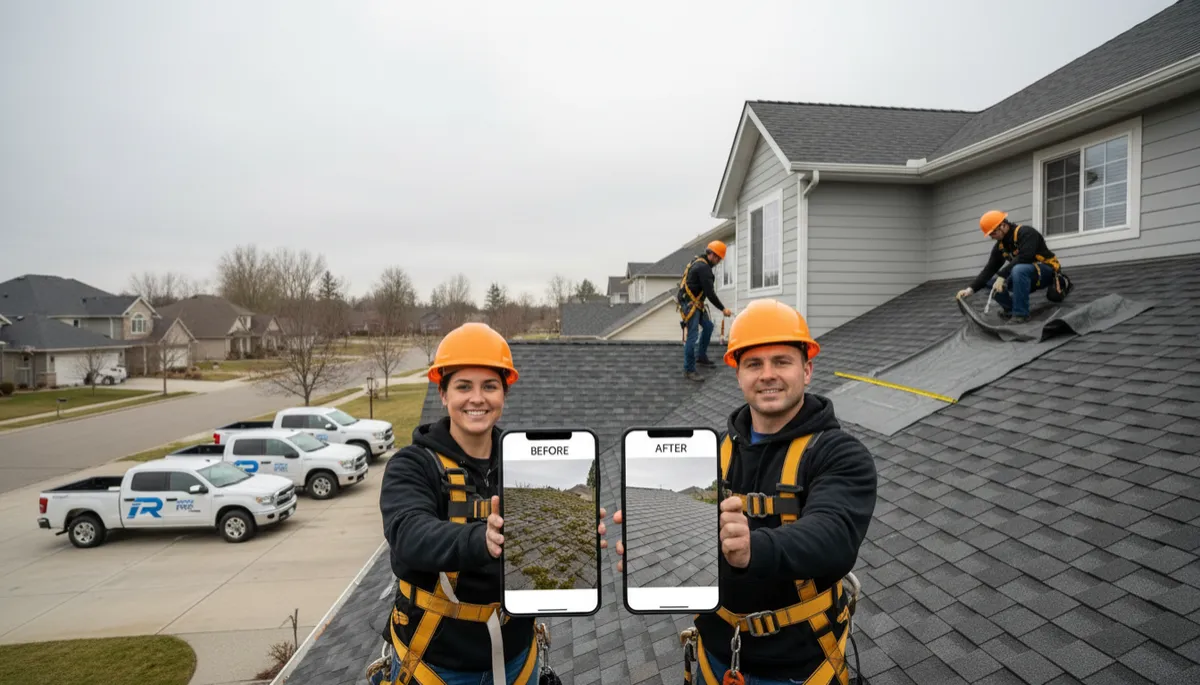
Documented before and after photos support both Facebook ads and homeowner trust.
5. Creative and Inquiry Paths That Respect the Homeowner
For owners in your revenue range, creative is less about clever slogans and more about clarity, proof, and ease of response.
Authentic Visuals: Before and After That Tell the Story
Use real job site photos from your market:
Clear before and after views of full replacements, framed at homeowner eye level
Short vertical videos walking the roof after completion, pointing out details like flashing and ventilation
Crews at work with visible safety practices and clean job sites
These visuals double as sales tools when your estimators meet property owners. A consistent documentation process makes it easier to repurpose real project evidence in both your advertising and your follow up.
Inquiry Forms Versus Dedicated Landing Pages
You have two primary inquiry paths:
Instant forms on Facebook. These forms keep the user inside the platform. They can be convenient and fast to complete. You can add concise qualification questions and required fields to filter out some noise, such as service area, property type, or whether there is an active leak or visible concern.
Dedicated landing pages. These pages sit on your own site. They allow you to show more project evidence, reviews, and a clear explanation of what happens after someone submits. They require proper tracking, such as Meta Pixel, UTM parameters, and call tracking, along with fast load times and mobile friendly layouts.
Neither approach universally produces cheaper or better inquiries. The right mix depends on your audience, offer, and follow up process. In practice, you can compare instant forms and landing pages by looking at qualification rates, completed estimates, signed jobs, and acquisition costs using your own campaign data. Whichever path you choose, keep qualification questions focused, make the next step clear, and ensure the form connects cleanly into your CRM and follow up systems.
6. Common Facebook Mistakes Roofing Owners Make
Across roofing companies in your revenue band, the same errors appear repeatedly. Each one disconnects advertising from actual business outcomes.
Vague, we do everything messages. Ads that say all your roofing needs without naming a specific problem, service, or area rarely perform well. Specificity helps attract the right projects and filter out work that does not fit your model.
Generic or stock imagery. Generic visuals do not show your craftsmanship, safety practices, or local context. You miss a chance to demonstrate that you complete work similar to the projects you want to win.
Unfulfillable offers. Promising emergency response or specific time guarantees when you do not have staffing or on call rotations to support them creates operational strain and negative experiences. Your offer should match your real capacity and margins and clearly state when your team is available.
Counting duplicates as opportunities. The same project, even if the decision maker submits a form twice or both calls and fills out a form, is one opportunity, not two. Inflated counts hide issues in qualification and follow up. Tracking at the unique project level tied to property and contact details creates a more accurate view of performance.
Judging campaigns only by cost per lead. A low cost inquiry that never converts can be more expensive than a higher cost inquiry that turns into a strong project. Reviewing cost per completed estimate and cost per signed job by campaign gives a more reliable picture of acquisition economics.
Scaling prematurely. Owners sometimes increase budgets quickly after a short period of promising form volume before confirming whether estimates are completing and jobs are closing. It is more disciplined to wait until you have enough data on qualified opportunities, completed estimates, and signed jobs to understand the economics of a campaign.
7. Five Concrete Action Steps for Roofing Owners
Choose one service and one area. Decide whether this campaign is for planned replacements, repairs, or storm inspections, and define the ZIP codes or neighborhoods where you want more work. Document how those jobs move through your current workflow from inquiry to production complete. This gives you a baseline to compare against as Facebook inquiries enter the system.
Prepare an honest offer. Draft an offer you can consistently deliver with current staffing and suppliers. Confirm response expectations, appointment availability, and any incentives with your production and finance leads before advertising it. Clarity on what you can reliably do is more valuable than a dramatic promise that strains your team.
Build a clear inquiry path. Decide whether you will start with instant forms, landing pages, or both. Map the steps from ad click to booked estimate. Configure your CRM so each inquiry from Facebook is tagged, assigned to an owner, and moved through stages such as new, acknowledged, contact attempts in progress, contacted, qualified, estimate booked, estimate completed, and won or lost. ActivatorSystem supports roofing companies with paid advertising structure, CRM configuration, and automated follow up so leads are not lost in inboxes and spreadsheets.
Test a limited set of messages. Launch with a small number of clear ad angles per service situation, not many scattered variations. For example, you might compare planned replacement assessments, leak or repair triage, and storm condition documentation. Give each enough budget and time to produce data on qualified opportunities and completed estimates before changing direction.
Review inquiry handling and outcomes weekly. On a regular schedule, review Facebook sourced inquiries with your sales lead. Distinguish between acknowledgment, contact attempts, and successful contact. Confirm that automation stops or adjusts when someone replies, books, reschedules, declines, opts out, or has documented manual contact. Set an attempt limit and final disposition for unreached inquiries. Evaluate acquisition economics using inquiry groups that have had enough time to progress, and avoid giving multiple campaigns full credit for the same job by counting at the unique project level. Resources like ActivatorSystem’s roofing lead follow up guidance can support this review.
8. Direct Answers to Five Common Facebook Roofing FAQs
Do Facebook ads work for roofing companies?
Facebook ads can support roofing growth when they are aligned with your services, geography, and sales process. The platform itself does not guarantee results. What matters is how well your campaigns target the right projects, how quickly and consistently your team follows up, how you qualify opportunities, and how you measure performance through completed estimates and signed jobs. When owners treat Facebook as part of a disciplined acquisition system, it has the potential to become a reliable channel rather than a one time experiment.
How much should a roofer spend on Facebook?
Appropriate spend depends on your acquisition economics, service area, available testing funds, and estimator capacity. A company with higher average job values and strong close rates may be able to justify more aggressive testing than a company with limited capacity or thin margins. Work backward from your acceptable cost per acquired job, your expected close rates from Facebook sourced opportunities, and the number of projects you can realistically complete, then set a test budget that you can track carefully and afford to learn from.
What should a Facebook roofing ad offer?
Effective offers speak to a specific problem and set a clear expectation. Examples include a planned roof replacement assessment with discussion of condition and options, a repair or leak consultation during stated service hours, or a storm related inspection to document visible conditions and discuss appropriate next steps. Avoid vague free estimates without context. The offer should also describe what happens after someone submits so property owners understand how and when your team will respond.
Should ads use an instant form or a landing page?
Both options can work. Instant forms can be convenient for people already inside Facebook and may reduce the steps required to submit an inquiry. Landing pages can provide more context, show more project evidence, and help pre frame your company. Rather than assuming one is always better, compare them in your own data. Look at qualification rates, completed estimates, signed jobs, and total acquisition costs for each path. The best choice is the one that produces sustainable economics and fits your follow up process.
How do I know if Facebook leads are worthwhile?
Track inquiries through your full workflow. For each campaign, measure unique projects, qualified opportunities, booked and completed estimates, signed jobs, and contract value. Distinguish between acknowledgment, contact attempts, and successful contact, and preserve unknown sources rather than forcing guesses. Retain cancellation history and avoid double counting when multiple campaigns touch the same project. When you can see cost per completed estimate and cost per signed job for a sufficiently mature group of inquiries, you can compare Facebook to other channels like search, local service listings, and referrals based on your own numbers.
9. A Practical Next Step
ActivatorSystem is a marketing and client acquisition service for roofing and exterior contractors that supports paid advertising, lead capture, CRM configuration, and automated follow up. Contractors own inspections, estimates, pricing, closing, and production. ActivatorSystem’s role is to help connect the acquisition components into one coherent system so you can make better decisions about where to invest and how to grow.
Want to see where your Facebook campaign is losing opportunities? Share your advertising spend, unique inquiry count, qualified opportunity count, and completed estimates with ActivatorSystem.