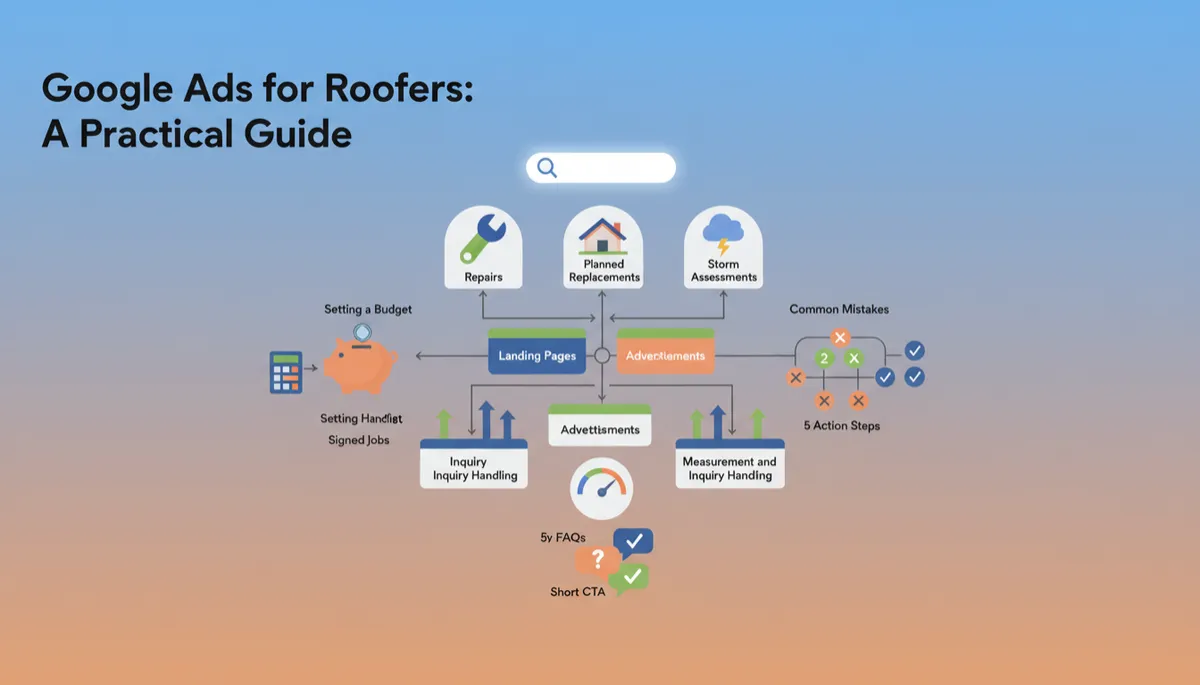
Google Ads for Roofers: A Practical Guide
Roofing Marketing, Google Ads for Roofers
Google Ads for Roofers: A Practical Guide
A practical Google Ads plan for a roofing company begins with clearly defining your roofing service, real service area, search intent you want to attract, honest advertisement, suitable landing page, reliable inquiry handler, and measurement through estimates issued and signed jobs won. This guide keeps everything grounded in roofing work, not marketing jargon, so you can decide whether Google Ads can be a dependable client acquisition system for your business with ActivatorSystem or on your own.
Start with a clear definition of success
Before touching Google Ads, define what you want the campaign to bring into your calendar. For roofing, that means deciding on:
The specific roofing service you want to promote, such as repairs, planned replacements, storm assessments, or a mix that matches your business model.
A realistic service area you can reach profitably and respond to with your current crews and schedule.
The search intent you want to attract, such as urgent leak help, planned replacement estimates, or storm related inspections where you have capacity.
An honest advertisement that reflects what you actually do, where you do it, and how you currently schedule work.
A suitable landing page or destination that matches the promise in the ad and makes it straightforward to inquire or call.
A dependable inquiry handler, whether owner, office staff, or an external service, with clear responsibility for responding, qualifying, and scheduling next steps.
Clear measurement through estimates and signed jobs, instead of relying only on clicks or form submissions.
Define the roofing work you want, the area you serve, and who will handle each inquiry before committing advertising funds.
Define the work you want from advertising
A strong roofing campaign does not try to catch every possible job. It focuses. You should clearly distinguish repairs, planned replacements, and storm related assessments, then decide which you want to prioritize and under what conditions, based on your services and capacity.
Repairs and smaller roofing problems
Repair work can keep crews productive and create future replacement opportunities when it fits your schedule and pricing structure. Think in conditions that match your business:
If your crews have meaningful downtime and you want more short term work, then a repair focused campaign can aim at searches such as roof leak repair today, emergency roof tarping, or flat roof patch, within areas you can realistically serve.
If your schedule is full and you prefer larger projects, then you may narrow repair coverage, adjust your service area, or shift more of your budget toward work that aligns with your current goals.
Planned replacements and upgrade projects
Planned replacements typically involve homeowners who are open to scheduling assessments and discussing options. Your approach should match your actual offerings:
If your business focuses on residential replacement, then your campaign can emphasize searches such as roof replacement in city, new roof estimate, or asphalt shingle roof replacement in neighborhoods where you want more projects.
If you actively promote specific materials or systems, then you can reflect that in your keywords and content instead of suggesting materials you do not install.
Storm related assessments and inspections
Storm related assessments can create concentrated demand after hail, wind, or other weather events. These opportunities also require careful expectations and clear internal rules:
If you choose to offer storm related inspections and have the capacity to manage them, then your messaging can reference recent verified local weather and invite homeowners in affected areas to request an inspection, without implying specific damage, coverage, or claim outcomes.
If you prefer retail work and do not want to focus on claims, then you can limit storm related messaging and keep your attention on planned replacement or repair services that fit your process.
Be explicit inside your company about which types of roofing work you want from advertising and which you will decline or refer, so your budget and crews stay aligned.
Work with keyword intent and real searches
Keywords are not just words. They represent intent. Your campaign should group keywords by what the homeowner is likely trying to do, in a way that matches your actual services. Here are practical, roofing specific examples:
Emergency repair intent: roof leaking now, roof leak repair near me, 24 hour roofer city. These searches often come from people who want to speak with someone quickly, so your ads and pages should only invite this work when your team can acknowledge and respond in a way that matches your availability.
Replacement intent: roof replacement city, new roof estimate, replace shingle roof cost. These searches often involve comparing contractors and scheduling assessments. Your content should make it easy to understand your process and request an estimate.
Storm assessment intent: hail damage roof inspector, insurance roof inspection, storm damage roofing contractor. These searches often follow local weather events. Your pages and conversations should focus on inspections, documentation, and next steps, without promising claim approvals or specific insurance results.
In Google Ads, you can review search term reports to see examples of what people typed before clicking. This is where you remove irrelevant traffic, such as do it yourself searches or out of area queries, and refine your keyword list and negative keywords. Regularly reviewing this data helps you keep your spend closer to the roofing work you actually want.
Group keywords by intent that matches your services, and keep trimming search terms that do not align with the roofing work you want to pursue.
Align ads, services, and inquiry destinations
Matching the advertisement to the service and inquiry destination is critical. A homeowner who searches for help with a specific roofing problem and lands on a page that does not clearly address that problem is less likely to continue. The ad, the landing page, and the way the inquiry is handled should tell a consistent story that reflects what you truly offer.
Illustrative message concepts for replacement services
Illustrative replacement message concept: Planning a roof replacement in [SERVICE AREA]? Request an assessment to discuss your roof, available options, and the next steps.
Clicks from this type of message should go to a destination that clearly addresses replacement work, such as photos of completed projects, an outline of your assessment process, and a simple way to request an appointment. Any credentials, warranties, or financing details you publish should reflect what your company actually offers and can substantiate.
Illustrative message concepts for repair services
Illustrative repair message concept: Need help with a roof leak in [SERVICE AREA]? Tell us about the problem and property location. Contact our team to discuss service availability.
These messages should point to a destination that makes it easy to describe the issue, share contact details, and understand what will happen next. Avoid promising specific response times, materials, or availability in your advertising unless your current operations support those promises.
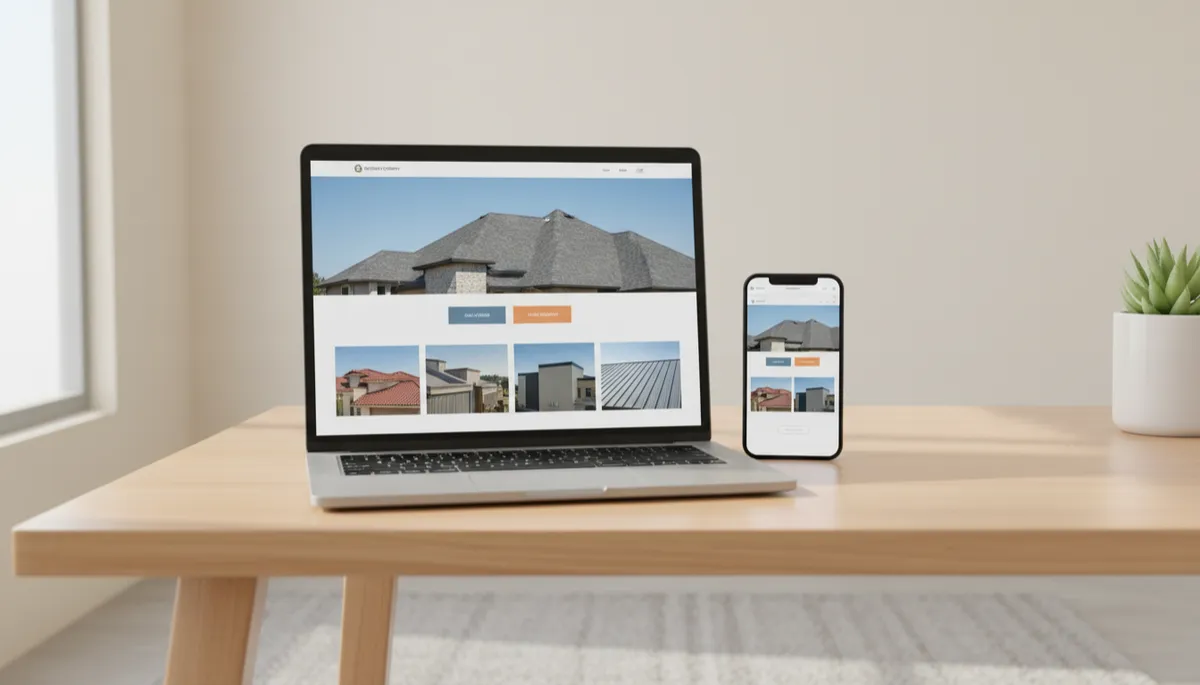
Dedicated service pages can help match roofing searches to specific next steps.
Shape inquiry destinations around your services and capacity
Your landing page or primary inquiry destination is where Google Ads either contributes to booked work or consumes budget without clear outcomes. For roofing, a strong destination reflects what you actually provide and how you handle new projects:
Service details: A clear explanation of the service being promoted, such as asphalt shingle roof replacement, residential leak repair, or hail damage inspections for insurance claims, along with the types of roofs and properties you serve when those services are available.
Authentic evidence: Real project photos, short case descriptions, and recent reviews drawn from your own work. Stock images can support the layout, but homeowners benefit from seeing what your company has actually completed.
Credentials: License numbers, insurance details, manufacturer relationships, warranties, and service areas that you can verify. Only publish credentials and offers that you truly maintain.
Contact options: A prominent phone number and a concise form that collects enough information to understand the project, such as name, address, contact details, and a brief description. If you offer text or chat, make sure those channels are staffed according to the expectations you set.
Response expectations: Simple, accurate statements about how and when you respond, based on your current staffing and hours. After hours messages should clearly state when someone will follow up and what the homeowner can expect next.
A homepage can work when it clearly reflects the advertised service and next step. A dedicated service page can provide a closer match. Evaluate actual results instead of assuming one structure will always perform better.
Hypothetical campaign path from spend to signed jobs
To make this discussion more concrete, consider the following hypothetical campaign path for a roofing company that wants to understand how advertising spend might relate to inquiries and later stages. These figures are illustrative assumptions, not client results or industry benchmarks:
Stage | Hypothetical value |
|---|---|
Advertising spend | $4,500 |
Unique project inquiries | 45 |
Advertising cost per inquiry | $100 |
Qualified opportunities | 30 |
Qualification rate | Two thirds |
Booked appointments | 24 |
Booking rate from qualified opportunities | 80 percent |
Completed estimates | 18 |
Appointment completion rate | 75 percent |
Signed jobs | 6 |
Completed estimate to signed job conversion | One third |
Advertising cost per signed job | $750 |
In this illustration, advertising spend refers only to the media spend in Google Ads. It excludes management, creative, software, and other acquisition expenses. Advertising cost per signed job is not a fully loaded customer acquisition cost.
These figures do not establish profitability. Job values, direct costs, cancellations, completion outcomes, and other expenses still matter. Inquiries from a given period may lead to appointments, estimates, contracts, installation, and payment over a longer timeline, so grouping inquiries by acquisition period helps you review mature outcomes without assuming that all results arrive immediately.
Plan budgets around inquiries and capacity
Budget planning for roofing Google Ads depends on your market, service mix, available testing funds, acquisition economics, and estimator capacity. Instead of starting from a universal monthly number, you can work backward from an inquiry target and an assumed advertising cost per inquiry that reflects your risk tolerance for a test.
Planning relationship: Planned advertising spend equals target unique inquiries multiplied by assumed advertising cost per inquiry.
Using the hypothetical assumptions above, 45 inquiries at an assumed advertising cost per inquiry of $100 yields a planned advertising spend of $4,500. This is a planning calculation, not a prediction that $4,500 will produce 45 inquiries. Actual results can differ in either direction, which is why tracking and review are essential. Assumed inquiry costs should come from relevant historical data where available, or from a clearly labeled testing hypothesis when you are starting without prior data. Available funds and risk tolerance determine the spending limit for a test; the expected cost per inquiry helps shape expectations but should not override those limits.
Start with how many unique project inquiries you can responsibly pursue and support, then plan advertising spend around that target instead of guessing a budget in isolation.
Measure qualification and later stages accurately
Measurement and inquiry handling are where many roofing Google Ads campaigns struggle. It is not enough to count clicks or raw leads. You need clear definitions for each stage and a way to record what actually happens with each project opportunity.
Define a qualified opportunity
A qualified opportunity is a unique project where successful communication with a homeowner or authorized decision maker confirms service area, service fit, a genuine roofing need, recorded timing, and an agreed next step.
A tracked call, call duration, click, or form submission does not automatically establish qualification. A click alone is an advertising interaction, not an inquiry. Calls and form submissions require review and successful communication before qualification.
Keep the following stages separate when you review your campaigns: inquiries, qualified opportunities, booked appointments, completed estimates, signed contracts, completed jobs, and collected cash. This separation helps you see where outcomes are strong and where process changes may be needed.
Track sources without overstating attribution
Record the source and campaign for each inquiry when you can, while preserving unknown sources where the origin is not clear from your systems or from the conversation.
Merge duplicate inquiries for the same project into one record, retain a history of cancellations or reschedules, and avoid giving multiple campaigns full credit for a single job.
Whatever tools you use, the aim is the same: to connect advertising activity to qualified opportunities and later stages without overstating what your tracking can prove.
Handle inquiries, follow up, and reviews with clear standards
Inquiry handling covers more than answering the phone. It includes how you acknowledge new inquiries, how many times you attempt contact, and how you close the loop when someone cannot be reached or chooses not to proceed.
Distinguish acknowledgment and contact attempts
Acknowledgment is the first confirmation that you received an inquiry. It can be an automated message, a manual text, or a call, and it should accurately reflect your current hours and expected response times.
Contact attempts are the specific calls, texts, or emails your team makes to reach the homeowner or decision maker. These should be logged with dates, channels, and outcomes.
Successful contact occurs when you speak with or exchange clear messages with the decision maker and can move the inquiry to qualified, not interested, or another defined status.
Response standards should be achievable based on your staffing and hours. After hours messages must match actual availability rather than promising responses that your team cannot consistently deliver.
Use automation carefully and close out unreached inquiries
Automation can help with acknowledgments and reminders, but it must stop or adjust when someone replies, books, reschedules, declines, opts out, or receives documented manual contact. Systems should reflect the current status rather than continuing to send generic messages.
Unreached inquiries should have a clear attempt limit and final disposition, such as unable to contact after a set number of attempts. This keeps your pipeline realistic and helps you interpret conversion rates correctly.
Review handling and campaign performance regularly, such as weekly for process checks and on longer intervals for economic evaluation. When you assess sales economics, use inquiry groups that have had enough time to progress through estimates and decisions, rather than shifting budgets based on one week of signed work. Signed work should not be called profitable until completion outcomes and relevant costs are reviewed.
Common mistakes to avoid in roofing Google Ads campaigns
Sending all traffic to a page that does not clearly match the advertised service and next step, whether that page is a homepage or a service page.
Treating repairs, planned replacements, and storm related assessments as identical in your messaging and measurement, even when your internal processes and economics differ.
Ignoring search term reports and paying for irrelevant or out of area clicks without regular pruning of keywords and negatives.
Advertising availability during hours when your acknowledgment and response paths do not reflect how and when your team can actually respond.
Judging campaigns only on clicks or early stage leads instead of following inquiries through qualification, estimates, and signed work over a realistic time frame.
Five practical action steps for campaign setup
Choose one service and a realistic service area. Decide whether you are testing repairs, replacements, or storm related assessments, and define an area you can serve reliably with your current crews and estimators.
Review relevant search intent and prepare accurate message concepts. Identify search phrases that match the chosen service and craft illustrative message concepts that reflect what you actually offer, without overstating credentials or availability.
Build a clear inquiry destination with authentic evidence. Use a homepage or service page that clearly matches the advertised service, includes real examples of your work, and explains how to request help or an estimate.
Check tracking, account access, inquiry ownership, and response coverage. Confirm who owns the advertising accounts, who can log into them, how inquiries are captured in your CRM, and who is responsible for acknowledgments and follow up during business hours and after hours. Ownership and access depend on your agreement and setup with any partners or agencies.
Run a focused test within available funds and evaluate outcomes as inquiries mature. Apply a budget that fits your risk tolerance, monitor inquiries, qualification, and later stages over time, and adjust based on observed results instead of short term impressions.
Five questions roofing companies often ask about Google Ads
Do Google Ads work for roofing companies?
Google Ads can support roofing companies when the advertising, inquiry handling, and sales process are aligned. The key is to attract searches that match your services, track inquiries through qualification and estimates, and review whether the resulting work fits your economics and capacity. Results vary by market, offer, and execution, so careful testing and measurement are essential.
How much should a roofer spend on Google Ads?
There is no single correct budget for every roofer. A practical approach is to decide how many unique project inquiries you want to test in a period, choose an assumed advertising cost per inquiry that fits your risk tolerance, and use the planning relationship planned advertising spend equals target unique inquiries multiplied by assumed advertising cost per inquiry. Assumed inquiry costs should be based on relevant historical data when you have it, or on a clearly labeled testing hypothesis when you do not. Available funds and risk tolerance set the upper limit for spending; the expected cost per inquiry helps you plan within that limit rather than determine it.
Which keywords should a roofing company target?
Start with keywords that match the services you actually want to provide and the way homeowners describe those needs. For example, you might focus on roof leak repair, roof replacement in city, or hail damage roof inspection when those services and locations fit your business. Use search term reports to remove irrelevant phrases and add negatives over time so that your spend stays closer to the roofing work you are prepared to handle.
Should roofing ads send people to the homepage or a service page?
Either can work when it matches the advertised service and makes the next step clear. A homepage that clearly explains your main services and how to request help can perform well for some campaigns. A dedicated service page can bring the visitor closer to the specific problem or project type the ad described. The practical approach is to test destinations that align with your structure and review actual inquiry, qualification, and estimate outcomes before deciding which path is better for your company.
How do I know whether Google Ads are producing worthwhile roofing inquiries?
Track each inquiry from the initial click or call through qualification, appointments, estimates, and signed contracts. Compare your advertising spend for a given period with the number of unique project inquiries, qualified opportunities, completed estimates, and signed jobs that can be reasonably connected to that spend. Review job values, direct costs, and completion outcomes before deciding whether the work is worthwhile. Google Search Ads, Local Services Ads, and organic visibility can all contribute inquiries, so it is important to record sources where known without assuming that one channel deserves full credit for every result.
Use ActivatorSystem to support your roofing advertising and follow up
ActivatorSystem is a marketing and client acquisition service for roofing and exterior contractors. The team supports paid advertising, lead capture, CRM configuration, and automated follow up so that your company can see and manage more of the path from advertising to qualified opportunities. Contractors remain responsible for inspections, estimates, pricing, closing, and production, while ActivatorSystem helps align campaigns and systems with your growth plans.
If you want to explore paid campaigns, you can learn more about roofing and exterior advertising support, review options for CRM configuration and integration, and study detailed guidance on roofing lead follow up.
Want to understand what your Google Ads spending is producing? Share your advertising spend, unique inquiries, qualified opportunities, and completed estimates with ActivatorSystem by requesting a strategy consultation.