Grow a Roofing Company Beyond Storms and Referrals
Roofing Business Strategy, Demand Generation, Retail Acquisition
How to Build a Roofing Company That Does Not Depend on Storms or Referrals
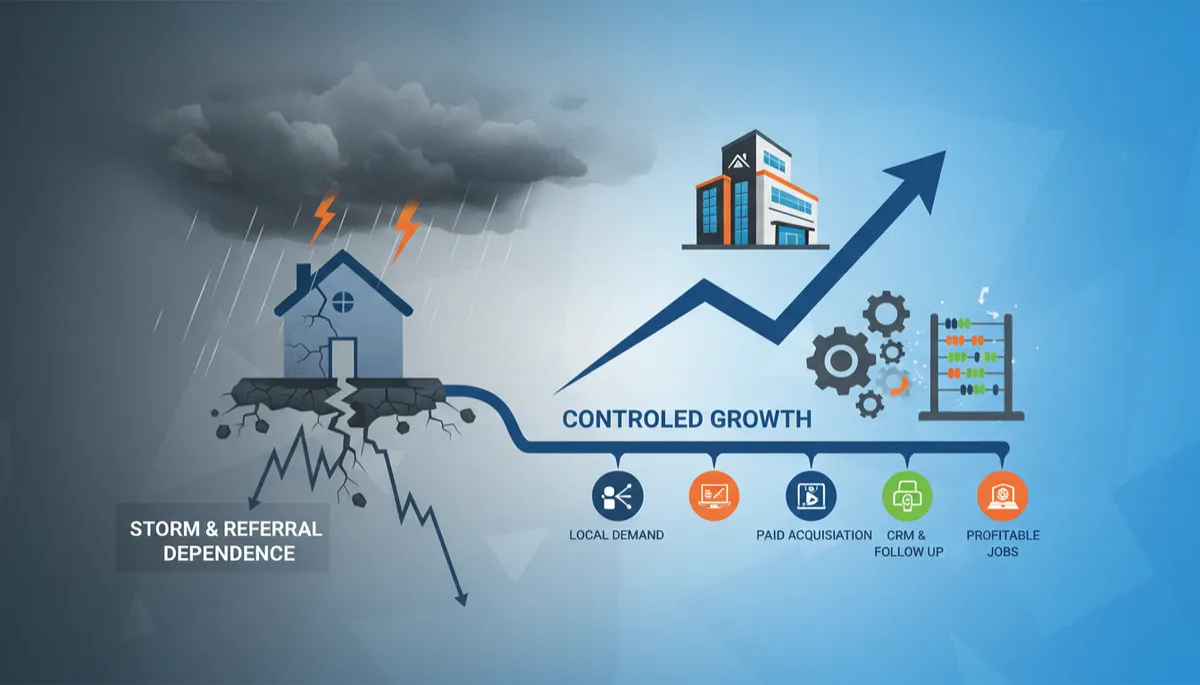
If you are running a $2 million to $10 million roofing company, storms and referrals probably drive most of your best jobs. They are valuable, but you cannot schedule a hailstorm or force a wave of word of mouth exactly when you need revenue. The practical path to more control is to build a retail acquisition process that connects local demand, relevant service pages, paid acquisition, clear lead ownership, estimate follow up, and completed job economics. Start by deciding how much revenue must come from sources other than storms and referrals. Then work backward using required completed jobs, estimates, inquiries, and acquisition spending. The goal is not to abandon storm or referral work. It is to rebalance your demand mix so slow weather or quiet referral months hurt less and your company can grow on purpose, not just when the sky cooperates.
Step 1: Diagnose How Dependent You Really Are
Before you design a stronger demand system, you need a clear view of where your revenue and profit actually come from. That means reviewing the last 12 months of completed revenue and gross profit, not just leads or contracts written. Completed work is what keeps the business alive and funds growth decisions.
Most roofing CRMs and accounting tools allow you to export jobs with fields like job type, revenue, gross profit, and original lead source. If you are on platforms such as JobNimbus or AccuLynx, you can usually export core job data for analysis and then decide which additional fields to track going forward.
Separate Acquisition Source from Job Type
Many roofing companies lump storm and referral into big buckets and stop there. That hides crucial detail. A storm inspection inquiry can arrive through Google Ads, organic search, or a referral. A referred homeowner may end up buying a retail replacement instead of filing an insurance claim. If you treat storm and referral as mutually exclusive, you miss the overlap that reveals real dependence and opportunity.
Instead, track separate fields for each completed job, such as:
Acquisition source for the original inquiry, such as paid search, paid social, organic search, referrals, partnerships, repeat customers, or other sources you use such as yard signs and events.
Service type such as replacement, repair, maintenance, or other major services you offer.
Property category such as residential or commercial.
Storm involvement such as storm related or non storm related based on how the job was ultimately scoped and sold.
Then build a simple matrix that uses acquisition source on one axis and storm involvement on the other. Use columns such as Storm Involved, No Storm Involvement, and Unknown while keeping acquisition sources as rows. Filter separately by service type and residential or commercial property. Count each completed job once when you calculate how much of your completed revenue and gross profit depends on storms, referrals, or any other combined category. For example:
Acquisition Source | Storm Involved | No Storm Involvement | Unknown |
|---|---|---|---|
Paid search | Revenue plus GP | Revenue plus GP | Revenue plus GP |
Referrals | Revenue plus GP | Revenue plus GP | Revenue plus GP |
You do not need a perfect system to start. Even a manual export into a spreadsheet will show you:
The share of completed revenue coming from each acquisition source and job type.
The share of gross profit tied to those same intersections.
Key takeaway: Measure dependence by looking at the percentage of total completed revenue and gross profit that relies on storms or referrals. The level of concentration that is acceptable depends on your margins, cash reserves, capacity, and acquisition economics rather than a single benchmark for every company.
Step 2: Understand the Economics of Retail Acquisition
Once you know your mix, you can decide how much non storm, non referral revenue you want to create. That is where the math starts. For a roofing company in the $2 million to $10 million range, this should be treated as an annual program with clear targets, not just a quick test of a few ads.
Core Planning Formulas
Use these simple formulas to work backward from revenue to inquiries and marketing budget:
Required completed jobs equals target revenue from the selected acquisition program divided by average completed job value.
Required completed estimates equals required sold jobs divided by completed estimate to sold job rate.
Required unique inquiries equals required completed estimates divided by inquiry to completed estimate rate.
Planned marketing budget equals required unique inquiries multiplied by assumed total marketing cost per inquiry.
Advertising Spend vs Total Marketing Spend
Many owners only think about the dollars going into Google Ads or Meta Ads. That is just one piece. Total marketing spend per inquiry includes:
Advertising media such as clicks, impressions, and calls.
Management fees, whether internal or external.
Creative and landing pages including copy, design, and development.
Tracking and tools such as call tracking, form tracking, and reporting platforms.
Count each cost once. When ActivatorSystem plans paid programs or paid advertising for roofers, we focus on total cost per inquiry and total cost per acquired customer, not just ad spend. The percentage of revenue you invest in marketing should reflect your margins, cash position, capacity, and acquisition economics rather than a fixed percentage that applies to every company.
Contribution vs Customer Acquisition Cost
To judge whether a retail program is healthy, you need a clean definition of contribution and how marketing fits into full customer acquisition cost, often called CAC.
Contribution equals completed job revenue minus incremental selling and delivery costs, before marketing and fixed overhead.
Marketing cost per customer equals total marketing spend attributed to the program divided by number of customers acquired from that program.
Marketing cost per customer excludes sales costs such as commissions, sales salaries, or sales travel. Those belong in your full CAC and overall profitability analysis. For day to day planning, you are asking whether there is enough contribution left after marketing to justify this channel and scale it.
Key takeaway: If you do not know your true contribution per job, start with a handful of recent jobs, break down material, labor, and direct selling costs, and build from there.
Step 3: The ActivatorSystem Base Demand Framework
The ActivatorSystem Base Demand Framework helps roofing companies design a base level of demand that does not rely on storms or referrals. It centers on five decisions you can revisit each quarter or year.
1. Define the Work
Decide which services, service areas, and homeowner needs you want this program to support. For most companies in the $2 million to $10 million range, that means focusing on:
Profitable retail replacements in specific ZIP codes or cities.
High value roofs such as certain materials, neighborhoods, or home values.
Your website structure and content should mirror this decision. That is where focused SEO services for roofers and clear service pages come in.
2. Build Demand
Next, select a focused combination of:
Local search visibility through your Google Business Profile, reviews, and organic rankings for phrases such as roof replacement near me and related terms that match your chosen work.
Paid acquisition through Google Ads, Local Services Ads, and selected paid social campaigns that point to relevant, conversion focused pages and offers.
Local partnerships with real estate agents, property managers, or other contractors where you agree on what types of projects fit, how referrals are handled, and how quickly you respond.
The objective is a base layer of inquiries every month that are not tied to the last storm report on the news.
3. Convert Inquiries
Demand without conversion discipline is just noise. For your retail acquisition program, define a single owner responsible for how new inquiries are qualified and moved forward. That includes tailoring the process to different homeowner situations, such as whether they are comparing multiple bids, replacing a roof before a sale, or reacting to a recent leak.
Qualifying service fit including location, roof type, budget range, and timing so you do not overbook crews or chase poor fit work.
Scheduling inspections in a way that matches the homeowner's urgency, from same week visits for active leaks to planned appointments for projects tied to a remodel or move.
Explaining scope and financing options clearly so homeowners know what is included, what choices they have, and how payment can work if they are paying out of pocket.
This is where a defined conversion path and disciplined roofing lead follow up process make the difference between profitable growth and wasted budget.
4. Protect Contribution
As the program runs, track:
Acquisition costs per inquiry and per customer by channel.
Contribution per completed job before marketing and overhead so you know what each job can support.
Cancellations, reschedules, and no shows that erode margins and tie up crews or office time.
You are not just chasing more jobs. You are protecting contribution per crew day and per month so the business stays healthy as it grows.
5. Reduce Concentration Risk
Finally, review your dependence on:
Specific weather events or storm seasons that can change from year to year.
A single partner, salesperson, platform, or lead source that would be difficult to replace quickly.
The objective is not to have many channels. It is to have a reliable core of a few channels that you can scale, with storms and referrals layered on top as upside. The right mix depends on your market, crews, and economics rather than a fixed formula.
Step 4: A Complete Hypothetical Planning Example
Let us walk through a hypothetical example using the math from earlier. Assume:
A $3 million roofing company wants $900,000 in retail revenue from a planned retail acquisition program.
This $900,000 is the program's revenue responsibility within the company's overall plan, not automatically additional growth. Assume one job per customer and that all 60 sold jobs complete within the planning period. Cancellations and delays increase the pipeline required.
Given:
Average completed retail replacement value: $15,000.
Completed estimate to sold job rate: 25%.
Inquiry to completed estimate rate: 40%.
Assumed total marketing cost per inquiry: $150.
Calculations:
Metric | Value | Notes |
|---|---|---|
Target retail revenue | $900,000 | Annual program goal |
Required completed jobs | 60 | $900,000 divided by $15,000 |
Required completed estimates | 240 | 60 divided by 0.25 |
Required unique inquiries | 600 | 240 divided by 0.40 |
Annual total marketing budget | $90,000 | 600 multiplied by $150 |
Monthly budget average | $7,500 | $90,000 divided by 12 |
Total marketing cost per acquired customer | $1,500 | $90,000 divided by 60 |
Contribution per job before marketing | $4,500 | Hypothetical contribution |
Total contribution before marketing | $270,000 | 60 multiplied by $4,500 |
Contribution after marketing before fixed overhead and other expenses not already included | $180,000 | $270,000 minus $90,000 |
Key takeaway: In this hypothetical scenario, the company trades $90,000 in marketing for $180,000 in contribution after marketing and before fixed overhead and other expenses not already included, while building a controllable retail demand engine. Any sales costs already deducted in contribution should not be deducted again.
Step 5: Make the Operations Match the Plan
How Retail Replacement Selling Differs from Storm Response
Retail homeowners can arrive with very different motivations, timelines, and financial situations than storm driven insurance customers. Some are reacting to an active leak, some are planning a replacement before selling, and others are upgrading materials on their own schedule. Your internal process has to adjust to those differences.
Speed to response: A five minute internal response target during staffed hours for calls, texts, or emails can be one useful standard. After hours, define who owns next day outreach so inquiries from evenings and weekends are not ignored.
Sales process: A homeowner paying out of pocket may want to compare scopes, materials, and financing options, while an insurance driven project may require more emphasis on documentation and carrier coordination. Adjust your questions, explanations, and follow up to match the situation.
What Happens When Estimators Are Busy or Follow Up Breaks
When your estimators are buried in storm inspections, retail leads are usually the first to suffer. Common failure points include:
Inquiries that never get a call back or get a call days later when the homeowner has already chosen someone else.
Inspections completed but estimates delayed for weeks during heavy production, leaving homeowners uncertain and more likely to move on.
Estimates sent by email with no clear next step, no follow up schedule, and no owner of the opportunity.
To fix this, track each stage separately in your CRM and reporting, and give leads enough time to move through the pipeline before you judge results.
Meaningful contact where you actually connect with the homeowner.
Appointment booked for an inspection or consultation.
Inspection completed on site or virtually.
Estimate delivered with a documented date and amount.
Contract signed as a clear commitment from the homeowner.
Job scheduled on the production calendar with a defined start date.
Job completed in the field according to the agreed scope.
Payment collected in line with your terms.
JobNimbus, AccuLynx, and similar CRMs can be set up to reflect these stages in different ways. The key is assigning clear ownership for each stage, defining how quickly new inquiries should be handled during staffed hours, and reviewing completed outcomes only after leads have had enough time to progress. You can schedule a 90 day operational review, but profitability analysis must allow enough time for the relevant leads to become completed jobs.
Step 6: What Most Roofers Get Wrong About Base Demand
Even strong companies in the $2 million to $10 million range fall into predictable traps when they try to grow beyond storms and referrals:
Treating storm driven revenue as proof of a repeatable process. Storms create urgency and insurance money. That can hide weak follow up, inconsistent sales skills, and poor tracking. When those same teams handle different homeowner situations, results often change.
Assuming referrals have no cost. Referral jobs still require sales time, office time, and sometimes discounts or favors. They are valuable, but they are not free and they are not scalable on command.
Spreading budgets too thin. A small amount of money in many channels rarely beats a focused program in one or two well chosen channels backed by strong follow up and clear goals.
Using one script for very different homeowners. A homeowner replacing a roof before selling, a landlord managing multiple properties, and a family reacting to a sudden leak may need different qualification questions, scope explanations, and financing conversations.
Increasing lead volume before fixing follow up or capacity. More leads into a broken system just means more missed calls, slower estimates, and wasted marketing dollars.
Dependence on a single advertising platform. Building your entire retail program on one platform's algorithm or policy is another form of concentration risk. Over time, having at least two reliable channels gives you more flexibility when one changes.
Step 7: Five Concrete Action Steps to Start Rebalancing Demand
Audit revenue and contribution by source and job type. Pull 12 months of completed jobs, tag by acquisition source, service type, property category, and storm involvement, and build the matrix. Calculate revenue and gross profit shares for each intersection. This is your baseline dependence map on storms and referrals.
Set a realistic revenue responsibility for a retail acquisition program. Decide how much non storm, non referral revenue you want in the next 12 months and run the math on required jobs, estimates, and inquiries using your real conversion rates where possible.
Build a service specific conversion path. For your chosen retail service and area, map the steps from search or ad click to booked inspection and signed contract. Align your website pages, forms, call handling, and CRM stages specifically to that path, not a generic contact flow.
Test a sustainable marketing budget and review lead outcomes. Commit to a test period such as 90 days with a defined monthly budget and clear expectations for inquiries, estimates, and jobs. Review outcomes weekly including response times, show rates, close rates, and contribution after marketing once leads have had time to progress.
Expand when economics support it, adding sources as capacity allows. Once a channel shows stable economics and a manageable sales workload, gradually increase budget or add a second channel. Avoid jumping to more leads before your team and systems can handle them.
Step 8: Frequently Asked Questions from Roofing Owners
1. How can a roofing company grow without relying on storms?
Treat retail and non storm work as its own line of business with clear revenue responsibility, budget, and process. Connect local search, paid acquisition, and partnerships into one system, then back it with defined lead handling, response standards, and follow up so storms and referrals become upside, not your only plan.
2. How do roofers generate retail leads?
Established companies often use a mix of Google search, Google Local Services Ads, local SEO, reviews, and selected paid social campaigns tied to clear offers. ActivatorSystem connects these channels into one acquisition system so you can see which inquiries turn into completed jobs and contribution, not just clicks or form fills.
3. Are referrals enough?
Referrals are valuable and should be protected, but they are unpredictable and hard to scale on a schedule. If your growth targets, crew capacity, or overhead require more consistent volume, you need controllable channels you can dial up or down alongside your referral base.
4. How much should be budgeted for retail lead generation?
Start by modeling your own numbers. Work backward from target revenue, average job size, contribution, and realistic conversion rates. Then test a monthly budget that fits your cash reserves, capacity, and risk tolerance instead of relying on a generic percentage of revenue that may not match your situation.
5. How do we reduce seasonal swings?
Seasonal swings are part of roofing, but you can soften them by building year round retail demand, offering services that fit shoulder seasons such as repairs and inspections, and balancing residential and commercial work where it makes sense. A defined acquisition program gives you more levers when one season slows.
6. What should be tracked before increasing marketing?
Track inquiry source and response time, conversion from inquiry to completed estimate and from estimate to sold job by channel, and average job value and contribution. With this foundation, you can judge whether additional marketing produces profitable growth instead of just more activity or higher lead counts.
A More Stable Roofing Business Starts with Your Demand Mix
Want to see how dependent your roofing business is on storms and referrals? Share your revenue mix, average job value, marketing spend, and close rate. ActivatorSystem can help you identify a practical starting point. Request a strategy consultation to discuss your demand mix and next steps.