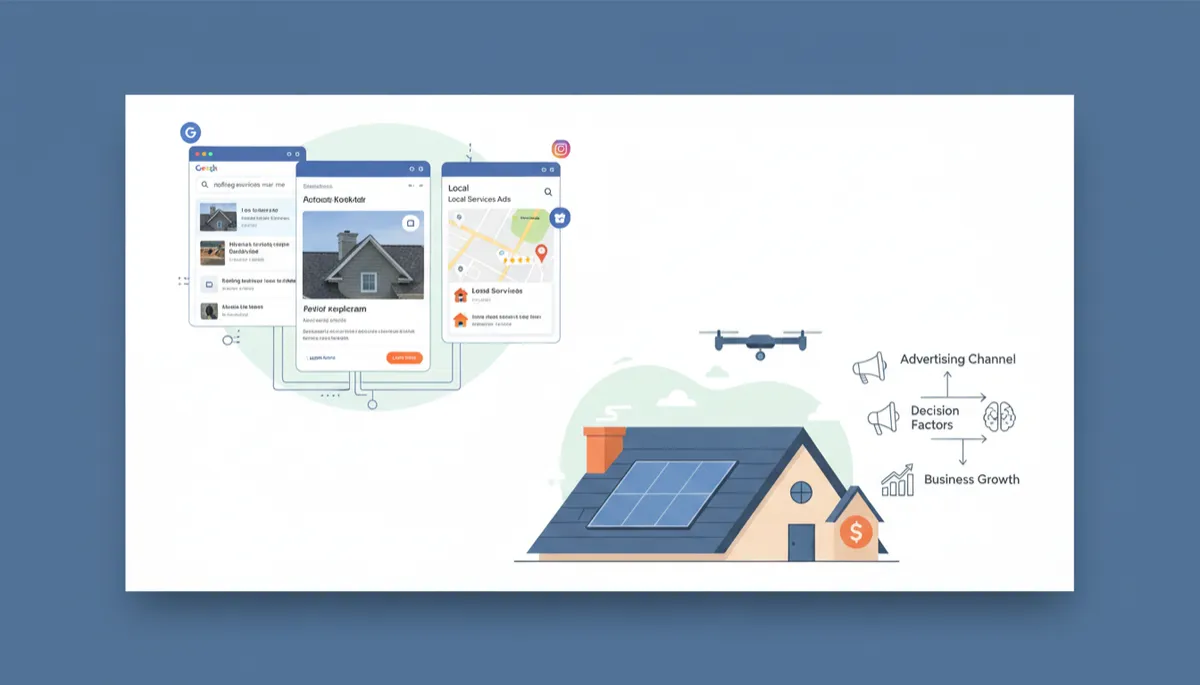
Google Ads vs. LSA vs. Facebook Ads for Roofers
Roofing Marketing, Google Ads, Local Services Ads, Facebook Ads
Google Ads vs. Local Services Ads vs. Facebook Ads for Roofers: Where Should You Spend Your Money?
Google Search Ads and Local Services Ads can help roofers reach homeowners actively searching for roofing services. Facebook and Instagram ads can introduce your business, promote a relevant offer, and reconnect with previous visitors. Where you should spend first depends on your local market, budget, reputation, and ability to turn inquiries into sold jobs. A limited budget may be better concentrated on one well-measured channel before expanding.
1. Google Search Ads vs. Local Services Ads vs. Facebook Ads for Roofers: a side by side comparison
In this guide, “Google Ads” refers to Google Search Ads text ads on Google search results, not YouTube or Display. “Facebook Ads” refers to Meta advertising, including both Facebook and Instagram placements. “Local Services Ads” (LSAs) are a distinct Google format that shows verified local providers in prominent local Search and Maps placements, with pay per lead billing (Google Local Services Ads overview).
Factor | Google Search Ads | Local Services Ads | Facebook & Instagram Ads |
|---|---|---|---|
Typical customer intent | High intent homeowners actively searching for roofing help now | High intent ready to call or message a local roofer | Mixed scrolling social feeds; you create interest and demand |
Advertising format | Text ads on Google search results pages (Search Ads basics) | Local provider cards with rating, reviews, and call/message buttons (LSA format) | Image, video, and carousel ads in feeds, Stories, Reels, and more (Meta lead ads overview) |
Charging model | Pay per click (PPC), optimized for conversions or leads | Pay per valid lead calls, messages, or bookings that meet criteria | Pay per impression or click, optimized for leads or conversions |
Lead destination | Your landing page or website, then calls or forms to your team | Calls and messages routed through Google’s Local Services interface | Instant forms, website landing pages, or direct messages |
Required assets | Ad copy, keyword structure, landing pages, tracking setup | Business profile, reviews, and any additional verification steps required for your category and location (current LSA eligibility) | Project photos or videos, clear offer, instant form or landing page, tracking |
Main operational challenge | Controlling wasted clicks and irrelevant search terms | Maintaining reviews, responsiveness, and lead quality over time | Standing out in the feed and following up consistently with leads |
Which platform should I test first?
Google Search Ads: Consider this when homeowners are searching for your services and you want control over search targeting and landing pages.
Local Services Ads: Consider this when your business is eligible, has a credible review profile, and can reliably handle incoming calls and messages.
Facebook and Instagram Ads: Consider this when you have strong project visuals, a relevant offer, and consistent lead follow-up.
Limited budget: Start with one focused test and measure cost per sold job before expanding.
Optimizing for leads does not always mean you are billed per lead. Google Search and Meta can optimize toward lead submissions while still charging per click or impression. Local Services Ads are the only format in this comparison that bills per valid lead by default.
2. When Google Search Ads make sense for roofers
Capturing high intent searchers
When a homeowner types “emergency roof repair near me” or “roof replacement estimate,” they are signaling strong intent. Google Search Ads place you in front of that demand at the exact moment they are looking. According to Google’s own documentation, search campaigns can be optimized for conversions and leads based on your goals (Search campaigns overview).
Service specific campaigns and location targeting
For roofers, Search Ads work best when campaigns are structured around specific services and geographies, for example:
Emergency leak repair and tarping
Full roof replacement and re roofing
Storm and hail damage inspections and insurance work
Metal, tile, or premium roofing upgrades
Tight location targeting by city, ZIP, or radius helps match your service area and crew capacity. This is especially important when storms hit and search volume spikes in specific neighborhoods, not across your entire metro area.
Search term relevance and negative keywords
One common Google Ads problem for roofers is wasted spend on irrelevant searches: “DIY roof patch kit,” “roofing jobs,” or “free roofing classes.” Regularly reviewing search term reports and adding negative keywords is essential to protect your budget. This is true whether you use more manual search campaigns or newer automated formats.
Landing pages and conversion tracking
A relevant landing page that matches the search term “Hail Damage Roof Inspections in Dallas,” for example, can make it easier for visitors to understand the service and take the next step; test performance against your existing page. You should track:
Calls from call tracking numbers on the page
Form submissions and chat inquiries
Booked inspections or estimate appointments
Google supports conversion tracking and lead measurement directly within campaigns (Search Ads measurement), which allows you to optimize toward leads instead of clicks alone.
Managing repair vs. replacement inquiries
Many roofers want more replacement jobs. With Search Ads, you can:
Run separate campaigns for “repair” and “replacement” keywords
Qualify callers quickly to understand age, condition, and insurance status
Track which leads turn into replacements so you can adjust bids and budgets accordingly
ActivatorSystem connects Search Ads data with your lead and sales tracking so you can see not just cost per lead, but cost per sold replacement job across your campaigns.
3. When Local Services Ads make sense for roofers
Eligibility and pay per valid lead model
Local Services Ads are designed for verified local providers in categories such as roofing, plumbing, and HVAC (LSA eligibility). LSAs can appear prominently in local Search and Maps placements with your rating, reviews, and other profile details. Instead of paying per click, you pay per valid lead typically a call, message, or booking that meets Google’s criteria for your category. Eligible providers may display a Google Verified badge after meeting applicable requirements; review Google’s current documentation for your category, location, and account to understand what is required.
It is important to understand that a billable lead is not a guaranteed appointment or sale. You still need to answer quickly, qualify the homeowner, schedule the visit, and close the job. LSAs can reduce wasted clicks, but they do not remove the need for a strong sales process.
Profile accuracy, reviews, and responsiveness
Success with LSAs depends heavily on your profile:
Accurate services residential vs. commercial, repairs, replacements, emergency work, and materials you actually install
Clear service areas that match where you truly want to drive, not your whole state
Strong review volume and rating, ideally with recent reviews mentioning roofing specifically
Fast response to calls and messages Google tracks responsiveness and uses it as a factor
Because LSAs highlight your rating and reviews prominently, they tend to work best for roofers with an established reputation and a reliable customer service process.
2026–2027 transition into Performance Max pay per lead campaigns
Beginning in August 2026, Google started transitioning Local Services Ads for select U.S. home service advertisers into specialized Performance Max campaigns with pay per lead goals, managed inside Google Ads rather than a separate dashboard (Performance Max transition). The core principles remain the same keywordless targeting, Search and Maps placements only, and billing per valid lead but budgeting, reporting, and lead management move into the Google Ads interface.
This guide is not a migration tutorial. For roofers, the key takeaway is that LSAs are becoming more integrated with the rest of your Google Ads activity. If you already run Search Ads, the transition changes where you manage budgets and reporting, but historical performance reports do not automatically transfer. You will still pay per valid lead, not per click.
4. When Facebook and Instagram Ads make sense for roofers
Visual creative and credible offers
Meta platforms can help you test strong visuals and offers in front of homeowners who are not yet searching. Project photos, short videos, and before and after comparisons can stop the scroll and make your brand more memorable. Meta’s own lead ads format allows you to collect inquiries directly in Facebook or Instagram with prefilled contact details (Meta lead ads).
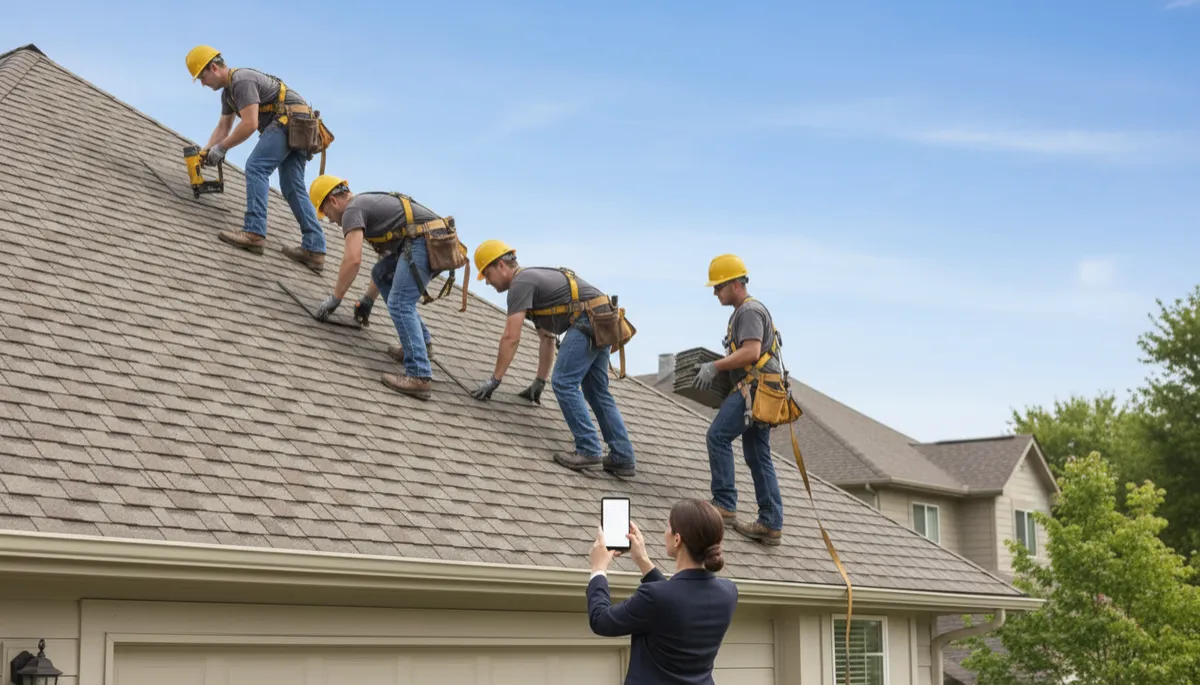
Consistent project photos and videos fuel higher performing Facebook and Instagram campaigns.
Effective offers often focus on inspections, education, or specific problems rather than “buy a new roof today.” Examples include:
“Free 15 minute storm damage check after last week’s hail”
“Metal roof assessment: is an upgrade worth it for your home?”
“Leak risk report for roofs over 15 years old in your neighborhood”
Instant forms, website inquiries, and qualification questions
You can run Meta campaigns to test:
Instant forms (lead ads) with custom questions such as roof age, type, and insurance status
Your website landing pages for more detailed education and scheduling tools
Messenger or Instagram DM for quick, conversational triage
Meta leads are often discussed as “cheap” or “poor quality.” In practice, quality depends on your targeting, offer, creative, and follow up. Well designed campaigns with clear qualification questions and fast response can produce profitable roofing jobs, particularly when combined with a strong CRM and automation layer, but results vary by market and execution.
Retargeting and homeowner education
Where audience eligibility, tracking signals, and applicable consent allow, Facebook and Instagram can help you reconnect with people who have:
Visited your roofing website from Google or referrals
Watched your videos or engaged with your posts
Filled out a form but did not book an appointment
Educational content “What to ask before hiring a roofer,” “How insurance roof claims really work,” or “Signs your roof may fail this winter” positions your company as a trusted advisor and keeps you top of mind until the homeowner is ready to act. Not every visitor or lead can always be retargeted; your options depend on privacy settings, tracking limitations, and consent.
5. Why the cheapest roofing lead is not always the cheapest customer
It is easy to focus on cost per lead (CPL) and assume the lowest CPL is best. For roofing, that can be misleading. What matters is cost per sold job and the value of those jobs.
Consider two hypothetical campaigns. These figures are illustrations, not platform benchmarks.
Campaign A spends $3,000, generates 100 unique leads, and wins three jobs. Its cost per lead is $30, and its ad-only cost per sold job is $1,000.
Campaign B spends $3,000, generates 30 unique leads, and wins six jobs. Its cost per lead is $100, and its ad-only cost per sold job is $500.
Campaign B has a higher cost per lead but a lower advertising cost per sold job. That does not establish which campaign is more profitable: job revenue, production costs, cancellations, and other acquisition expenses still matter.
Key Takeaway: Judge channels by cost per sold job, average job value, and margin, not just cost per lead.
6. Where should a roofing company spend its money first?
There is no single “best” platform for every roofer. Your starting point depends on local demand, your reputation, sales capacity, and how much control you want over targeting and messaging. Here are conditional recommendations:
Start with intent if search demand and reputation are strong
If your area has steady search volume for roofing terms, and you have a solid review profile, prioritize Google Search Ads and Local Services Ads to capture homeowners already looking for help.
Use LSAs when you want simpler, lead based billing and are confident in your responsiveness and review strength.
Add Facebook and Instagram when you have visual assets and follow up systems
If you have strong project photos, video, and a CRM or follow up system, Meta campaigns can generate additional leads and nurture past visitors at scale.
Meta is especially useful to test premium upgrades, storm response campaigns, and staying visible during slower search periods.
Consider budget, control needs, and proven economics
If you need tight control over keywords, bids, and search terms, Google Search Ads provide the most flexibility, especially with structured campaigns and negative keywords.
If your main constraint is time and operational simplicity, LSAs can be a focused way to buy calls and messages without building extensive landing pages.
If you want to build a brand, educate homeowners, and retarget website visitors, Meta is a strong complement to search based channels.
A reasonable test budget depends on your market’s click costs, expected lead volume, and sales cycle. In higher cost metros, you may need more spend to gather meaningful data. If your budget cannot support meaningful testing across multiple platforms, start with one channel. Expand when you have reliable conversion data, workable acquisition costs, and capacity for additional jobs. ActivatorSystem helps clients design test plans that align with their local economics and capacity rather than applying one size fits all numbers (Paid advertising for roofers).
7. What to fix before increasing advertising spend
Before you increase budgets on any platform, shore up the parts of your system that turn leads into revenue. Additional ad spend poured into a leaky process rarely produces sustainable growth.
Lead routing and response time
Every lead call, form, instant form, or message should route to a single, accountable system. Prompt responses help you start conversations while homeowners are still considering their options. Assign responsibility for every inquiry and track how quickly your team responds. We cover this in more detail in our guide to the roofing lead response five minute rule.
Qualification, appointment attendance, and sales tracking
Your team should consistently:
Ask basic qualification questions roof age, type, damage description, insurance involvement, and decision makers
Confirm appointments with reminders to reduce no shows
Record outcomes: qualified lead, estimate issued, won, lost, or cancelled
Without this data, you cannot tell which channels are producing real opportunities. Our article on roofing lead follow up systems outlines practical steps to tighten this process.
Capacity and measurement discipline
Finally, make sure you can handle the additional work. If your crews are booked eight weeks out and communication with customers is already strained, aggressive ad expansion may create more frustration than profit. Measure, at minimum:
Unique leads (deduplicated across platforms)
Qualified leads and booked appointments
Estimates delivered and jobs sold
Ad only costs and revenue from ad sourced jobs, without double counting leads that came through multiple channels
ActivatorSystem is built to help roofing and exterior contractors connect advertising, follow up, and search into one measurement framework so you can scale with clarity instead of guesswork.
8. Frequently asked questions about Google, Local Services Ads, and Facebook for roofers
Are Local Services Ads the same as Google Search Ads?
Local Services Ads are not the same as Google Search Ads; they are a separate format that shows verified local providers in prominent placements in Google Search and Maps. They are keywordless, rely on your business profile and verification, and bill per valid lead (LSA basics). Google Search Ads are traditional text ads that you manage with keywords, bids, and landing pages, and they typically bill per click (Search campaigns).
Are Facebook Ads worth it for roofing companies?
Facebook and Instagram can be worth testing for roofing companies when you treat them as visual, demand creation and nurturing channels rather than pure intent capture. They can be particularly effective for storm response campaigns, premium upgrades, retargeting eligible website visitors, and educating homeowners. Results depend on your creative, offers, targeting, and follow up, not on the platform alone (Meta lead ads guidance).
Which platform produces the cheapest roofing leads?
No single platform always produces the cheapest roofing leads; lead costs vary widely by market, competition, and execution. In some areas, Meta may produce lower cost per lead than Google Search; in others, LSAs may be competitive because you pay per valid lead. However, the cheapest lead is not always the cheapest customer. Focus on cost per sold job, average job value, and margin when comparing channels.
Should we run all three Google Search Ads, Local Services Ads, and Facebook/Instagram?
You do not need to run all three platforms at once; a phased approach is usually more sustainable. Start with the channel that best matches your current demand and capacity, then layer others as your systems mature. If your budget cannot support meaningful testing across multiple platforms, start with one channel. Expand when you have reliable conversion data, workable acquisition costs, and capacity for additional jobs. For example, you might begin with Google Search or LSAs, then add Meta retargeting and storm campaigns once tracking and follow up are in place.
How should we compare results across platforms?
You should compare results across platforms using a consistent framework rather than relying on headline metrics alone. Look at:
Unique leads and qualified leads per channel
Appointments set, estimates delivered, and jobs sold per channel
Ad only cost per sold job and total revenue generated from those jobs
Use your CRM to record lead sources and job outcomes, deduplicate inquiries, and apply a consistent attribution method. Platform reports may overlap, and some customer journeys cannot be tracked completely.
Plan your roofing advertising mix with ActivatorSystem
Choosing between Google Search Ads, Local Services Ads, and Facebook or Instagram is not about picking a universal winner. It is about aligning each channel with your local demand, service mix, reputation, sales capacity, and follow up process, and then measuring results with discipline.
ActivatorSystem partners with roofing and exterior contractors to design, implement, and optimize integrated client acquisition systems across these platforms. Want a clearer plan for your roofing advertising budget? Request a strategy consultation with ActivatorSystem to review your market, current results, and next advertising test.