How Many Roofing Leads Generate $1 Million in Revenue?
Roofing Leads, Revenue Planning, ActivatorSystem
How Many Roofing Leads Does It Actually Take to Generate $1 Million in Revenue?
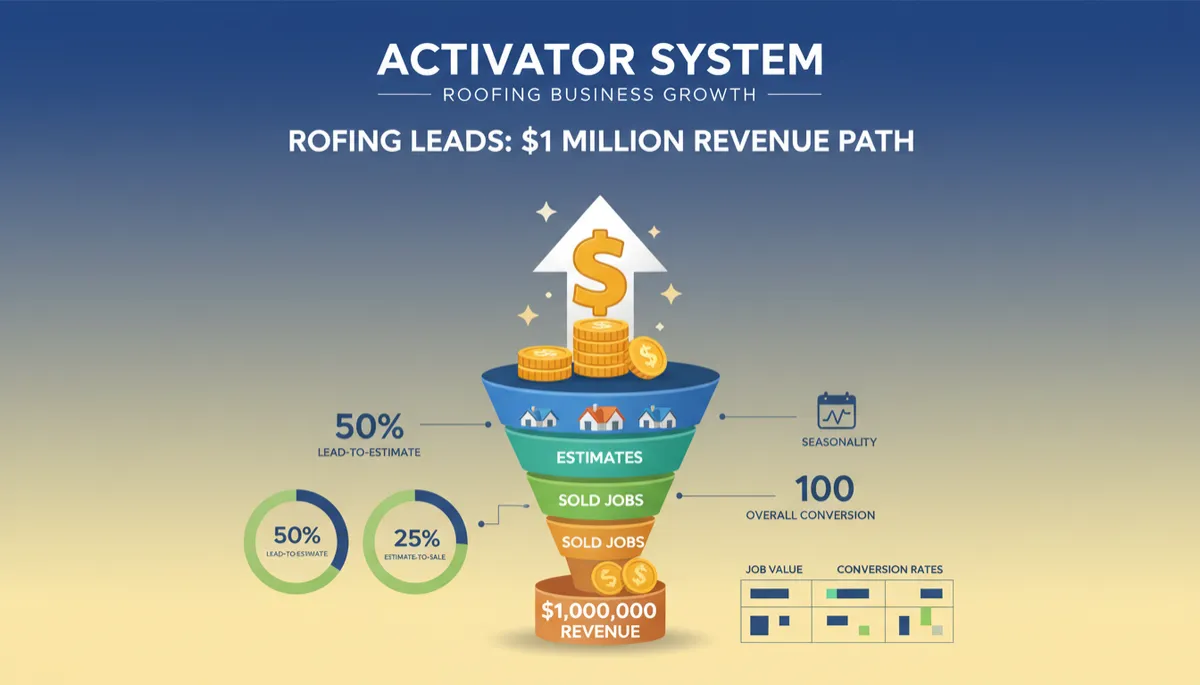
At a $10,000 average job value and a 10% lead-to-customer conversion rate, approximately 1,000 leads could produce 100 jobs and $1 million in annual revenue, assuming those jobs are completed within the year. These are hypothetical assumptions, not industry benchmarks or guaranteed results.
Your number could be much higher or lower. The calculation depends on your average job value, the percentage of leads that become customers, and how much revenue you already expect from existing work and referrals. Here is how to calculate a lead target for your roofing company.
Key takeaways:
Lead requirements depend on average job value and lead-to-customer conversion.
Subtract revenue already accounted for before calculating additional lead needs.
Track conversion by lead source before increasing ad spend.
1. How many roofing leads does it take to generate $1 million?
The number of leads you need is driven by this relationship:
Required leads = Revenue target ÷ (Average job value × Lead-to-customer conversion rate)
In this context, leads should be defined as unique inquiries about potential roofing projects. Repeat calls or messages about the same project should not be counted as additional leads.
Two inputs drive everything: average revenue per sold job, which is what you typically bill for a completed roofing project, and your overall lead-to-customer conversion rate, which is the percentage of inquiries that become paying, completed jobs. Change either number and your lead requirement changes immediately. That is why there is no single correct lead count for every roofing business or market.
In the hypothetical example used throughout this article, a $1,000,000 revenue target, a $10,000 average revenue per sold job, and a 10% overall lead-to-customer conversion rate produce a requirement of approximately 1,000 leads and 100 sold jobs, assuming all sold jobs are completed and recognized as revenue within the year. These figures are illustrative only, not industry benchmarks or guarantees.
Key Point: You do not control how many leads the market should give you, but you can control your pricing, service mix, and conversion process, which directly change how many leads you need to reach $1 million.
2. The three numbers that determine your roofing lead target
a) Average revenue per sold job
This is the average invoice amount for roofing projects you actually complete and recognize as revenue. It should reflect the same mix of work that your leads represent, including both replacements and repairs if both are part of your regular production. The higher this number, the fewer jobs and leads you need to hit $1 million in revenue. If you want to plan replacement leads separately from repair leads, calculate average revenue and conversion for each group separately so the math stays consistent. Average job value and conversion rates should always be calculated from the same group of leads and completed projects so you do not overstate how much revenue each lead is likely to produce.
b) Overall lead-to-customer conversion rate
This is the percentage of all inbound inquiries (calls, form fills, messages) that become completed, revenue-recognized jobs. It accounts for every drop-off in your funnel: leads that never book an estimate, estimates that are never completed, and proposals that do not close. This is not the same as your estimate close rate; it is broader and more realistic for planning revenue.
c) Revenue target and timeframe
In this article, we focus on an annual revenue target of $1,000,000, with the assumption that sold jobs are completed and revenue is recognized in the same year. Contracts signed, cash collected, and profit are different measures; here we are dealing strictly with recognized revenue from completed roofing work.
Important Assumption: All examples in this article are hypothetical. They are not industry benchmarks and not specific results from ActivatorSystem clients. Use them as a framework, not as targets you are guaranteed to hit.
3. A worked example from inquiry to completed roofing job
Hypothetical example: $1,000,000 in annual roofing revenue
Annual revenue target: $1,000,000
Average revenue per sold job: $10,000
Required sold jobs: 100 ($1,000,000 ÷ $10,000)
Now we layer in the funnel from first inquiry to completed job:
Lead-to-booked-estimate rate: 50% (half of leads schedule an estimate)
Booked-estimate-to-completed-estimate rate: 80% (some cancel or no-show)
Completed-estimate-to-sale rate: 25% (one in four estimates sold)
Multiply those three stages together to get your overall lead-to-customer conversion rate: 50% × 80% × 25% = 10%.
Applying the formula
Using the formula: Required leads = Revenue target ÷ (Average job value × Lead-to-customer conversion rate). The denominator is $10,000 × 0.10 = $1,000. So: $1,000,000 ÷ $1,000 = 1,000 leads.
Required annual leads: 1,000
That creates the following funnel:
1,000 leads → 500 booked estimates (50% of 1,000)
500 booked estimates → 400 completed estimates (80% of 500)
400 completed estimates → 100 sold jobs (25% of 400)
100 sold jobs × $10,000 = $1,000,000 in revenue
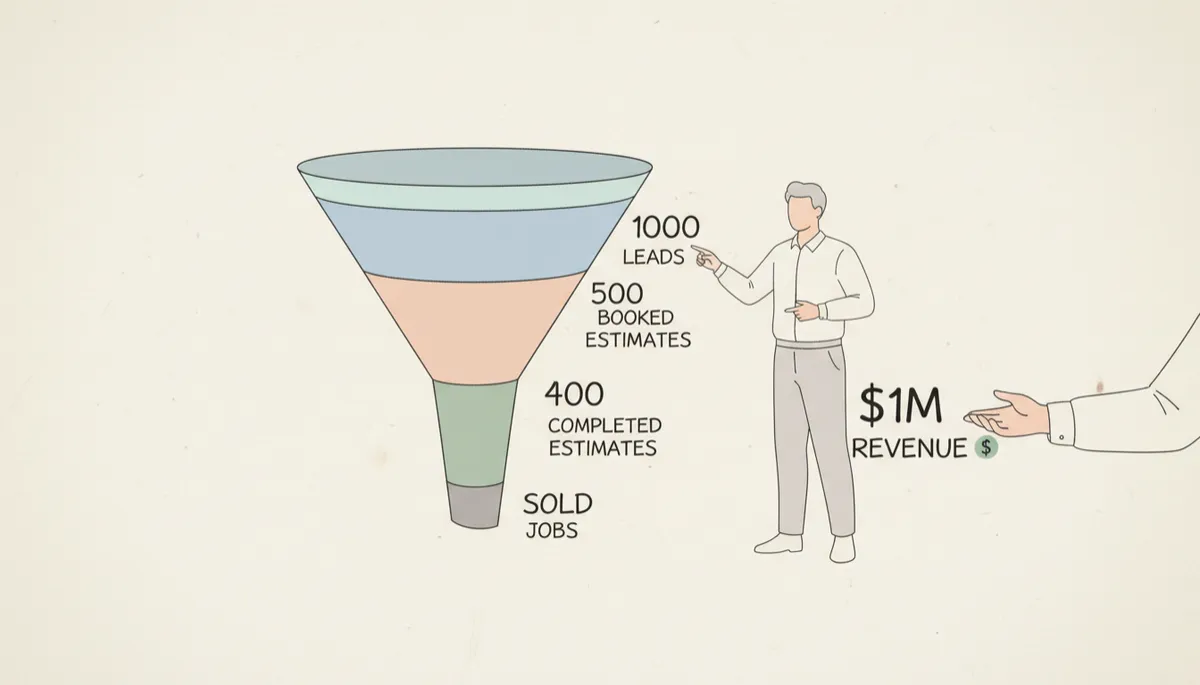
Visualizing your funnel makes revenue targets and lead requirements far more concrete.
Monthly averages and roofing seasonality
Spread evenly across the year, this hypothetical plan requires approximately 84 leads per month (1,000 ÷ 12) and 8 to 9 sold jobs per month (100 ÷ 12). In reality, roofing is highly seasonal. Many markets see more production and more leads in spring and summer, and fewer in winter. That means:
Your peak season lead target will likely be higher than 84 per month.
Your off-season target may be lower, but you still need a pipeline to feed the next busy period.
Planning Tip: Use a 12-month target for clarity, then build seasonal monthly targets based on your historical lead and install patterns.
4. How job value and conversion rates change the number of leads you need
To see how sensitive your lead requirement is, keep the revenue target at $1,000,000 and vary average job value and overall conversion rate. Every cell in the table below uses that same $1,000,000 revenue target and assumes that jobs are completed and recognized within the planning period.
Average revenue per job | 5% lead-to-customer conversion | 10% conversion | 20% conversion |
|---|---|---|---|
$5,000 | 4,000 leads | 2,000 leads | 1,000 leads |
$10,000 | 2,000 leads | 1,000 leads | 500 leads |
$20,000 | 1,000 leads | 500 leads | 250 leads |
The pattern is straightforward: better conversion and higher job values reduce your required lead volume. In practice, you should plug your own numbers into the core formula rather than relying on generic tables.
Practical takeaway: You can grow by getting more leads, but you can also grow by raising average job value and improving conversion. Both approaches can contribute to growth, depending on your market, capacity, and margins.
5. What those leads could cost using a $100 cost per lead
Hypothetical paid media cost per lead
Assume you acquire leads through paid channels at an average paid media cost per lead (CPL) of $100. For the 1,000-lead example above:
1,000 leads × $100 CPL = $100,000 in ad spend for the year.
Customer acquisition cost from paid media
With 1,000 leads producing 100 sold jobs, you are acquiring one customer for every 10 leads. At $100 per lead:
Paid media cost per customer = 10 leads × $100 = $1,000 per sold job. This acquisition cost reflects ad spend only and does not include agency fees, software, sales labor, or any other expenses required to win and complete the work.
Against an average job value of $10,000, this hypothetical scenario yields a 10:1 revenue-to-ad-spend ratio before considering all other costs.
Important: This ad spend calculation excludes overhead, labor, materials, sales commissions, software, and other costs. It is not a profit forecast. It is a way to understand how ad spend, lead volume, and revenue are connected.
ActivatorSystem helps roofing and exterior contractors acquire new inquiries through paid advertising and then track and manage those leads with CRM services so that your actual cost per lead and cost per job are measurable, not guessed.
6. How to calculate the target for your own roofing company
Step 1: Define your revenue target and timeframe
Decide on a clear revenue target (for example, $1,000,000 per year) and confirm that you are counting completed jobs where revenue is recognized, not just contracts signed or insurance approvals.
Step 2: Calculate your average revenue per sold job
Use last year’s data if available. Take total roofing revenue and divide by the number of completed jobs: Average revenue per sold job = Total roofing revenue ÷ Number of completed jobs. Make sure the revenue and job counts come from the same mix of work as the leads you are planning for so the average reflects reality. If you want to plan replacement leads separately from repair leads, calculate each group separately instead of combining them into one blended number.
Step 3: Determine your overall lead-to-customer conversion rate
Measure conversion by tracking a defined group of leads through to their outcomes. For example, take leads received during a previous quarter and measure how many eventually became completed jobs, allowing enough time for the sales and installation cycle. Dividing this month’s completed jobs by this month’s new inquiries can be misleading because those jobs may have come from older leads.
Step 4: Apply the formula to your numbers
Plug your own figures into: Required leads = Revenue target ÷ (Average job value × Lead-to-customer conversion rate). This will give you a realistic annual lead target. From there, build monthly and seasonal targets that match your market’s roofing seasonality.
Step 5: Account for existing revenue and referral work
If your company already has revenue booked or a reliable stream of repeat and referral business, calculate the remaining gap before setting a paid lead target. For example, if you expect $400,000 toward a $1,000,000 annual goal, the remaining gap is $600,000. At a $10,000 average job value and a 10% lead-to-customer conversion rate, filling that gap would require approximately 600 additional leads. Count each source of expected revenue once, and calculate conversion rates separately for referrals, exclusive advertising inquiries, and shared purchased leads rather than assuming they all perform alike.
Implementation Tip: ActivatorSystem’s CRM services are designed to help roofing and exterior contractors capture these numbers more reliably. A properly configured CRM can track lead sources and sales stages. Accurate revenue reporting also requires your team or connected systems to record job outcomes and values.
7. What to track before increasing your marketing budget
Before you invest more in advertising, make sure you are not simply paying to leak more leads through the same funnel. At a minimum, track:
Lead-to-booked-estimate rate: what percentage of inquiries schedule an appointment
Booked-estimate-to-completed-estimate-rate: how percentage of booked estimates actually take place.
Completed-estimate-to-sale rate: your estimate close rate
Follow-up and response improvements
Often, the fastest way to increase revenue is not more leads but better follow-up and faster response. If you are slow to call back, miss inquiries outside business hours, or follow up only once, your true conversion rate is likely lower than it could be. For deeper guidance, review:
Improving these two areas alone can lift your overall lead-to-customer conversion rate, which means you need fewer leads to achieve the same $1,000,000 revenue target.
8. Frequently Asked Questions
How many roofing leads do I need each month?
Using the hypothetical example, 1,000 annual leads translates to about 84 leads per month on average. Your actual monthly target should account for roofing seasonality. Use your own average revenue per job and conversion rate in the formula to set your annual target, then distribute that across months based on your historical busy and slow periods.
What is the difference between estimate close rate and lead-to-customer conversion rate?
Your estimate close rate measures how many completed estimates turn into sold jobs. Your overall lead-to-customer conversion rate measures how many total inquiries (including those that never book or complete an estimate) become completed jobs. For revenue planning, you need the broader lead-to-customer conversion rate because it reflects every stage where revenue can be lost.
Does $1,000,000 in roofing revenue mean $1,000,000 in profit?
No. In this article, $1,000,000 refers to recognized revenue from completed jobs. Profit is what remains after materials, labor, overhead, sales costs, marketing, and all other expenses. Contracts signed, cash collected, and profit are separate measures; here we are focusing on revenue to plan required leads and sold jobs.
Can better conversion reduce how many leads I need?
Yes. Improving follow-up, response time, and sales process increases your overall lead-to-customer conversion rate. Because required leads are calculated as Revenue target ÷ (Average job value × Lead-to-customer conversion rate), a higher conversion rate means fewer leads are needed to reach the same revenue goal. This is why process improvements and CRM tracking are as important as generating more inquiries.
9. Next steps: Build a measurable plan with ActivatorSystem
There is no universal answer to how many roofing leads it takes to generate $1,000,000 in revenue. The right number for your company depends on your average revenue per sold job, your true lead-to-customer conversion rate, and the seasonality of your market. With those numbers in place, you can set realistic lead targets, plan advertising spend, and focus on the parts of your funnel that will move you toward your revenue goals most efficiently.
ActivatorSystem partners with roofing and exterior contractors to connect paid advertising, CRM tracking, and lead follow-up into one integrated client acquisition system. If you are ready to move from guesswork to a measurable plan for roofing lead generation and conversion, we invite you to request a strategy consultation with the ActivatorSystem team and map out your path to your next $1,000,000 in roofing revenue.